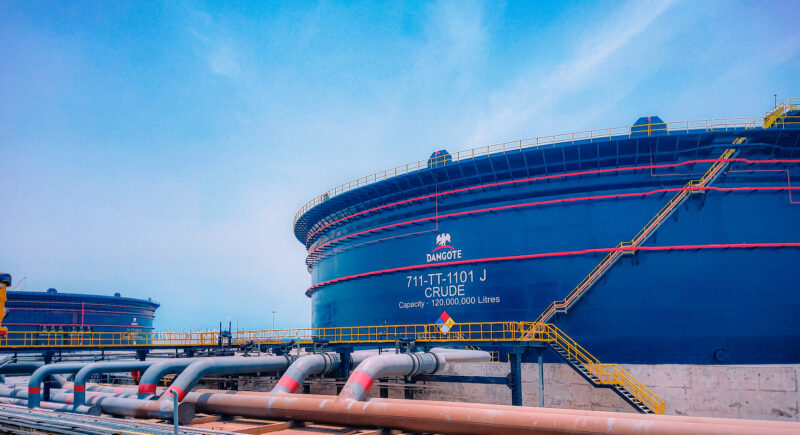

Dangote’s positive crude shift sees a second Ghana cargo arrive as the refinery cuts European intake ahead of major maintenance
Dangote Petroleum Refinery President and Chief Executive Aliko Dangote, alongside market analysts at Kpler, confirmed in Lagos on 12 December that the refinery had taken delivery of its second-ever crude cargo from Ghana as part of a positive crude shift that reduces reliance on European supplies.
Also read: Dangote launches N1trn education fund to empower students
The shipment, carrying Ghana’s Sankofa grade, arrived in November and underscored the refinery’s move to prioritise West African and domestic crude grades ahead of scheduled maintenance.
Industry data showed that crude arrivals at the plant averaged about 380,000 barrels per day between September and November.
The figure was roughly 30 per cent lower than volumes purchased during the July and August peak, reflecting operational adjustments and recurrent outages across key units.
Kpler reported that November receipts were dominated by Nigerian grades, chiefly Bonny Light, followed by Amenam, Forcados, Utapate and Qua Iboe.
Sankofa formed the only non-Nigerian component of the slate, reaffirming the refinery’s growing reliance on nearby producers that offer shorter voyage times and flexible scheduling during maintenance periods.
The decline in intake is linked to extensive work on the Residue Fluid Catalytic Cracking unit, which began a two-month shutdown on 4 December, and a one-week outage planned for the Crude Distillation Unit in late January.
Kpler noted that the RFCC had struggled with regenerator-related issues throughout the third quarter, cycling between offline and online modes before operators opted for a major overhaul.
As the refinery reduces runs, Nigeria’s downstream market is feeling the ripple effects.
Petrol output at the plant is expected to fall toward 80,000 barrels per day during the maintenance window, down from recent levels of 100,000 to 130,000 barrels per day.
The shortfall has pushed Nigeria’s petrol imports sharply higher, reaching about 300,000 barrels per day in November, the highest in more than a year.
Analysts suggested that the increased pull on European product may prompt refiners in the Netherlands and Belgium to lift crude runs in December to keep pace with Nigerian demand.
Kpler projected that national refinery runs could slip to about 320,000 to 350,000 barrels per day through February before rebounding above 500,000 barrels per day in April 2026 once maintenance concludes.
Despite the tightening domestic supply, Aliko Dangote assured consumers that the refinery would sustain market stability through the festive season.
He said the facility would supply 1.5 billion litres of petrol in both December and January, equal to 50 million litres per day, and increase volumes to 1.7 billion litres in February.
He added that the company had formally notified the Nigerian Midstream and Downstream Petroleum Regulatory Authority of its commitments.
Also read: Dangote Refinery engineer salary dispute deepens
The pledge was framed as part of the company’s long-standing effort to support the national interest, with Dangote describing the forthcoming supply as vital to ensuring uninterrupted fuel availability at a time of high seasonal demand.