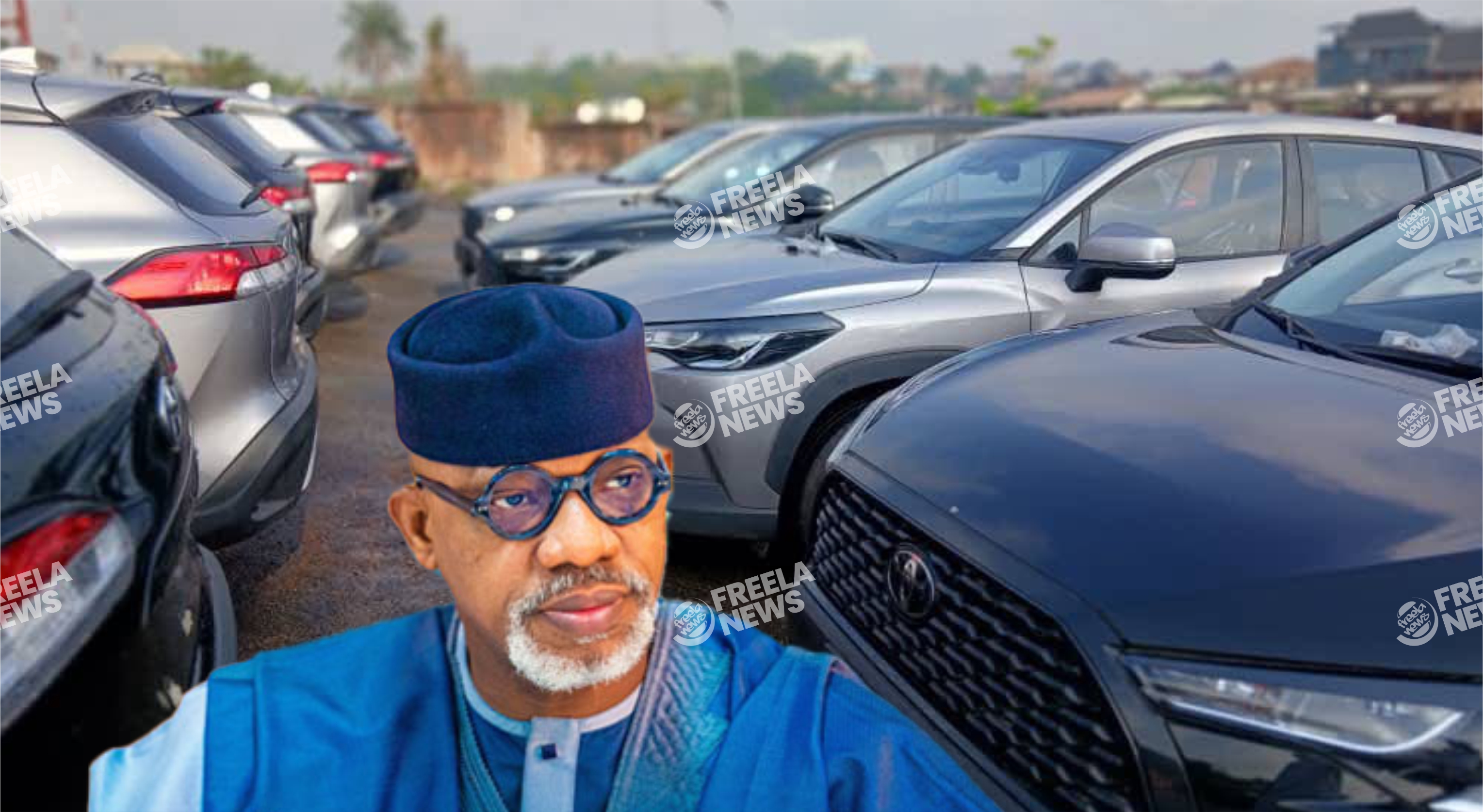

On Christmas Day 2025, Ogun State Governor Dapo Abiodun stood at the centre of a festive ceremony in Abeokuta as 20 brand new Toyota Corolla Cross SUVs were handed over to chairmen of the state’s local government areas.
Officially, it was a gesture of goodwill and a practical intervention to strengthen grassroots governance. Unofficially, it reopened an old Yoruba popular saying that refuses to fade from Nigeria’s political imagination: “A fi owo Abu se Abu lalejo.”
The saying, loosely translated, speaks of hosting Abu with Abu’s own money while pretending generosity.
It captures the subtle irony of power using resources that do not truly belong to it, then receiving applause for benevolence.
For many observers, that proverb now frames the meaning of Abiodun’s Christmas gift.
Represented by the Commissioner for Local Government and Chieftaincy Affairs, Ganiyu Hamzat, the governor said the SUVs were meant to improve efficiency and mobility, particularly for reaching rural communities. The chairmen beamed, cameras flashed, and festive cheer filled the venue.
Dr Mrs Afolasade Adeyemo, chairperson of ALGON in Ogun, praised the governor’s wider record in education, housing, healthcare and infrastructure. On the surface, it looked like cooperation between state and local governments at its best.
Yet beneath the polished optics lies a deeper national dispute that has refused to go away.
On July 11, 2024, Nigeria’s Supreme Court delivered what many described as a historic judgment, ordering that federal allocations be paid directly to the country’s 774 local governments.
The ruling, anchored on Section 162 of the Constitution, was meant to dismantle the long standing joint account system that left councils financially dependent on governors. It was designed to allow local governments fund roads, schools, health centres and basic services without interference.
More than a year later, that judgment remains largely unimplemented.
In December 2025, the Supreme Court itself expressed frustration, openly criticising the federal government for failing to enforce its own decision. Local government autonomy, in practice, remains more promise than reality.
It is against this background that Abiodun’s SUVs have been received with scepticism.
Critics argue that if local governments are meant to be autonomous and already receive monthly FAAC allocations, why should the state government be buying vehicles for them at all.
On social media, the reaction was swift.
One user asked bluntly how a state government could take local government funds and return them in the form of vehicles. Another invoked the proverb directly, accusing the governor of entertaining Abu with Abu’s own money after refusing him autonomy.
The timing only deepened suspicion.
The SUVs came months after local government elections in Ogun State, where the All Progressives Congress swept all 20 chairmanships amid allegations of irregularities.
With the Supreme Court ruling still hanging unenforced, many see the vehicles as a subtle incentive, a way of securing loyalty from chairmen who might otherwise press for financial independence.
Comments describing the move as impunity and elite comfort masquerading as development flooded online platforms.
Transparency has also been an issue. The Ogun State Government had not disclosed how much was spent on the vehicles or which budget line funded the purchase.
A brand new Toyota Highlander in Nigeria costs roughly between ₦125 million to over ₦150 million (NGN) for recent models like 2023/2024.
A brand new Toyota Land Cruiser Prado in Nigeria costs roughly ₦140 Million to over ₦167 Million Naira, depending on the model year (2024/2025)
If we multiply this by 20. That is approximately N3.4b Christmas Gifts for chairmen. Enough to build schools, good roads, hospitals etc.
Without official figures, speculation thrives.
Calls have grown louder for the government to disclose the procurement details in line with the Freedom of Information Act, if only to clear doubts over whether state resources or local government allocations were used.
This is not the first time Abiodun’s administration has faced criticism over vehicle purchases. In 2024, reports emerged of plans to procure Toyota SUVs worth about N2.4billion for state lawmakers, alongside hefty budgetary provisions linked to the governor’s office.
Such stories reinforce a broader narrative of questionable priorities in a country battling inflation, unemployment and widespread poverty.
The controversy has also fed into the national political debate.
On December 24, 2025, former Vice President Atiku Abubakar accused President Bola Tinubu of turning the Supreme Court ruling on local government autonomy into a political bargaining chip.
According to Atiku, allowing governors to ignore a final court judgment amounts to punishing communities rather than strengthening governance.
He insisted that Supreme Court decisions are final and warned that continued delay reflects executive overreach. Tinubu has hinted at enforcing the ruling through executive action but has so far stopped short, citing the need for consensus.
Supporters of Abiodun argue that the SUVs align with his “Building Our Future Together” agenda and are no different from similar provisions in other states.
They cite examples where vehicles and benefits are provided to public office holders as part of governance structures. To critics, however, such arguments miss the point. In a climate where many local roads remain impassable and basic services underfunded, gifting luxury SUVs to political office holders feels tone deaf.
The power of the “owo Abu” proverb lies in its simplicity.
If local governments were truly autonomous, they would decide how to spend their own funds, including whether to buy vehicles. The state would not need to play benefactor.
Until the Supreme Court ruling is enforced and until governments are fully transparent about how public money is spent, gestures like Abiodun’s Christmas SUVs will continue to attract cynicism rather than applause.
Also read: Atiku blackmails Tinubu over Dapo Abiodun, others refusal to pay LG allocations directly
Abu may smile at the hospitality, but the unease remains. Deep down, many Nigerians know who paid the bill. Severe the umblical cord and let the local governments breathe.

Ojelabi, the publisher of Freelanews, is an award winning and professionally trained mass communicator, who writes ruthlessly about pop culture, religion, politics and entertainment.