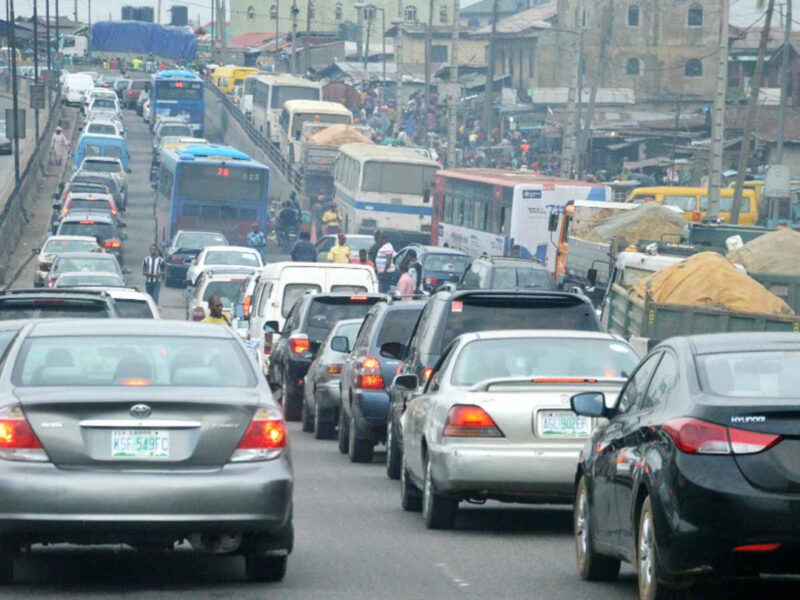

In a report made available to Freelanews, Financial Derivatives Company (FDC) Limited says every Lagos resident would have spent over six years in traffic by the time they clock 55 years.
According to the FDC, the state has one of the worst traffic gridlocks in the world, with commuters spending hours on the road and missing a major portion of their productive time before reaching their destinations.
In its most recent analysis, FDC, led by Nigerian economist Bismarck Rewane, also emphasized the economic forecast for 2022.
Residents of Lagos spent 1,080 hours in traffic every year, according to the Lagos-based research and investment firm, whereas residents of London, which is claimed to have the world’s worst traffic, spent about 148 hours.
The report read, “Lagosians are spending approximately 1,080 hours a year in traffic, compared to 148 hours in London, the city with the worst traffic jams in the world (excluding Nigeria and Egypt).
“This comes to 12.5 per cent of the time in a year. It also translates to 6.76 years in a life expectancy of 55 years.”
According to the report, compared to Lagos’ 1,080 hours, residents of Paris spend 140 hours in traffic, Brussels (134), Palermo (109), Moscow (108), Rome (107), Chicago (104), Lyon (102), New York (102), and Bucharest (98).
All efforts to solve the traffic challenge in Lagos by successive governments have been fruitless as there has not been any major breakthrough, leaving residents to languish for hours in the intractable hold-ups and wasting several man-hours.
Research organisations, like SBM Intelligence, earlier suggested an upgrade of the infrastructure in the water transport sector to encourage commuters to patronise boats and ferries to reduce the perennial traffic congestion in the state.
Other studies had advocated a mass movement mode of transportation, like the rail system, to move people in one of the world’s most populated cities.
The FDC report in other issues stated that the economic policy vagueness and “regulatory autocracy” plagued the Nigerian economy for the most part of 2021.
It stated, “It was a year best described as ‘in like a lion, and out like a lamb’. But in reality, it was almost the opposite because of mixed signals.
“The economic growth maintained a slow and steady path as was expected but could be threatened by a rude interruption of the Omicron variant and the spectre of precision lockdowns.
“This notwithstanding, Nigerians are still frustrated with data that shows falling inflation in an environment of higher prices.”
In its Christmas edition of the monthly report, the FDC further extrapolated possible exchange rate scenarios based on oil price sensitivity, giving an external boundary of N610/$ and an optimistic scenario of N530/$.

Ojelabi, the publisher of Freelanews, is an award winning and professionally trained mass communicator, who writes ruthlessly about pop culture, religion, politics and entertainment.