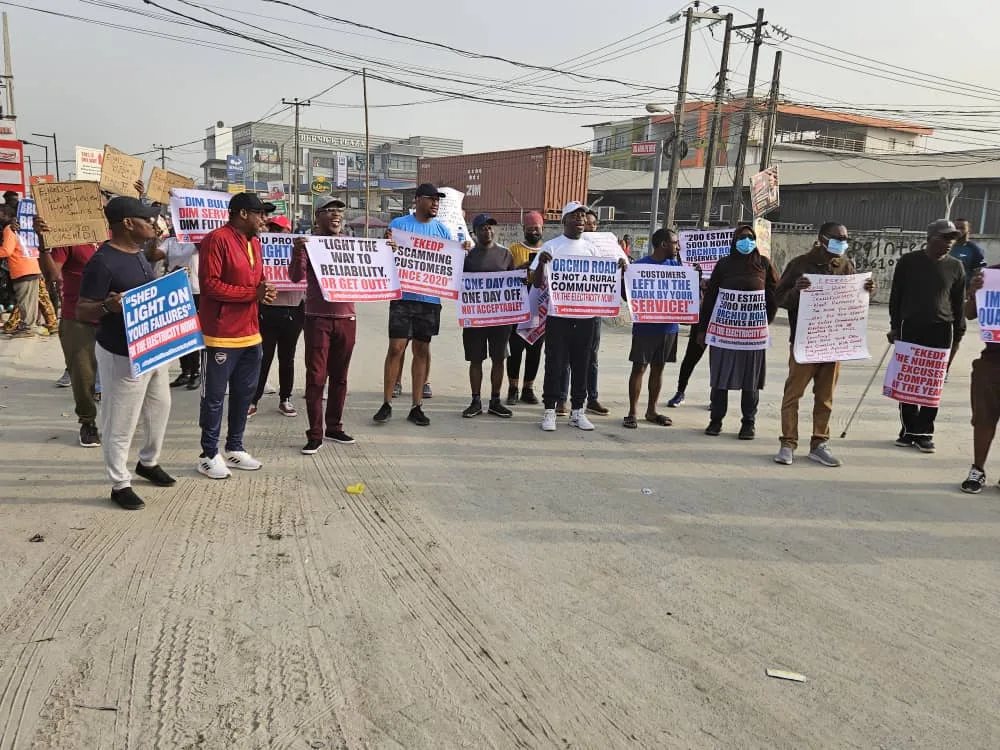

Residents of Orchid Road in Lekki, Lagos State, have threatened to stage monthly protests over persistent electricity outages, accusing Eko Electricity Distribution Company (Eko DisCo) and the Transmission Company of Nigeria (TCN) of failing to provide reliable power despite regular payment of bills.
The residents, under the Lekki Conservation Estate Community Development Area (LECECODA), staged a demonstration at Monife Roundabout over the weekend, displaying placards to express frustration over months of inadequate electricity supply.
Also read: Canada blocks Russia from 2027 world junior hockey
Some of the placards read, “We Pay Premium Rates But Get Zero Reliability!”, “Orchid Road Band B = Band Nothing” and “Orchid Road Deserves a Power Station”.
The protesters, comprising landlords, tenants, business owners and community leaders, said the outages had disrupted commercial activities, increased household expenses and forced estates to depend heavily on diesel generators.
Speaking during the protest, LECECODA President, Bode Akinwande, said the community had endured more than four months of poor electricity supply despite repeated efforts to resolve the problem through discussions with Eko DisCo.
He said residents received virtually no electricity throughout October but continued to receive bills running into millions of naira.

In the month of October, we did not receive two hours of supply cumulatively, and unfortunately, members of this community in various estates have received bills in the millions.
This is not acceptable to us, Akinwande said.
He explained that Orchid Road stretches about 7.5 kilometres and accommodates approximately 200 residential estates, alongside schools, restaurants, shopping malls, supermarkets, churches and mosques.
According to him, the area receives electricity through the Maroko 33kV feeder at Ajah but lacks a dedicated injection substation to serve its growing population.
Akinwande alleged that the feeder trips daily, sometimes at the slightest indication of rainfall, leaving residents without electricity for several days.
He added that power was occasionally restored for only two minutes after outages lasting four or five days.
The community leader also accused Eko DisCo and TCN of shifting responsibility for the persistent outages between themselves, leaving consumers to bear the burden.
He said the association wrote to Eko DisCo’s Acting Managing Director, Sharifat Adegbenro, on October 20, 2026, requesting a meeting to address the situation.
However, he expressed disappointment that the company only responded after becoming aware of the planned demonstration.

Akinwande warned that residents would return to the streets every month until electricity supply improved significantly.
“If we do not see stable power supply, next month we are going to gather again to let members of the community and Nigeria as a whole know what they have done,” he said.
He added that the protests would continue until the community recorded an appreciable improvement in supply.
A community stakeholder, Faith Oliver, said businesses along the corridor had suffered substantial losses, with some forced to close because of unreliable electricity.
She identified frozen food businesses, restaurants, supermarkets and shopping malls as particularly affected because of their dependence on refrigeration.
Oliver also lamented that some households could no longer pump water regularly due to the power situation.
The association’s immediate past president, Irene Osas, said the electricity crisis had persisted for more than a decade despite repeated engagements and agreements with the distribution company.
She disclosed that one estate spent about N6m monthly on diesel to supplement electricity supply and had accumulated debts to diesel suppliers.
Another resident, Engineer Olosho Saheed, accused Eko DisCo of issuing estimated bills even in estates where functioning electricity meters were available.
He said the unreliable supply had forced his estate to increase electricity charges collected from residents while struggling to cover the cost of diesel.
Saheed disclosed that the estate operated a 500kVA generator, which consumed between 600 and 800 litres of diesel daily.
We cannot continue with this.
Eko Power has to do better by us, and they have to improve, he said.
The Chairman of LECECODA’s Board of Trustees, Taiwo Enilolobo, questioned the continued billing of residents despite the poor service, claiming that between 95 and 98 per cent of consumers along the corridor paid their bills as and when due.
The association called on Eko DisCo to restore electricity supply in line with the community’s Band B classification or review its bills to reflect the actual service delivered.
It also demanded a technical audit of the Maroko 33kV feeder, a time-bound plan to address frequent tripping and a commitment to building a dedicated injection substation for Orchid Road.
The residents further urged TCN’s Ajah Transmission Station to explain the prolonged outages and work with Eko DisCo to restore stable electricity.
They also called on electricity regulators to investigate the service delivered to the community against its Band B classification over the preceding four months.
Also read: Canada blocks Russia from 2027 world junior hockey
Eko DisCo had yet to respond to messages and calls seeking its reaction to the allegations as of the time of filing the report.

Peculiar Adirika is a journalist and contributor to Freelanews.com, covering news, business, and public affairs.