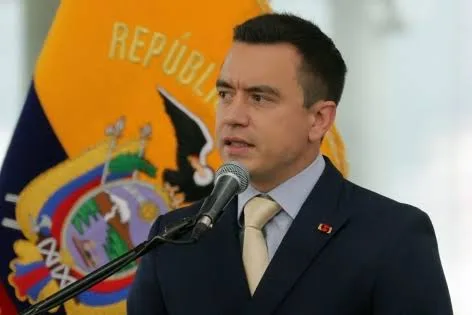

Ecuadorian President Daniel Noboa has denied that the United States operates a military base in the country, insisting that American personnel at Taura Air Base are involved only in temporary joint activities.
Noboa made the statement on Sunday, November 15, 2026, following a referendum in which Ecuadorian voters rejected a proposal to allow foreign military bases in the country.
Also read: Amazon loses 40 satellites in rocket launch failure
His denial came after an investigation by Agence France-Presse (AFP) documented an unusual deployment of US aircraft at Taura Air Base, near the port city of Guayaquil, as well as the installation of dozens of tents and other infrastructure.
The investigation, published in October, identified approximately 20 US military flights to the facility between June and mid-October.
It also obtained documents referring to the presence of American soldiers at the base.
Speaking to digital news outlet Altavoz, Noboa said the US personnel were in Ecuador as part of security cooperation between the two countries.

“Sometimes there’s a specific mission. Sometimes there’s a specific operation,” he said. “We work together. It’s not an American base. It’s an Ecuadoran base.”
However, the president did not address the aircraft movements documented by AFP and avoided a journalist’s request to visit the Taura facility.
The reported US deployment had also raised questions about its legal basis within Ecuador’s military establishment.
AFP reported that then-air force commander General Mauricio Salazar had asked the armed forces to clarify the legality of the deployment in a letter sent in September.
Salazar was subsequently removed from his position and reassigned to less senior duties.
The full scale of the American military presence has not been publicly disclosed.
Meanwhile, Quito and Washington have continued strengthening cooperation against drug trafficking and organised crime in the region.
The Pentagon, US Southern Command and Ecuador’s air force did not respond to AFP’s requests for information when the investigation was published.
Noboa had campaigned for constitutional changes that would reverse Ecuador’s prohibition on foreign military bases.

However, voters rejected the proposal in a referendum held in November 2025.
The result came amid growing security cooperation between Ecuador and the United States as the South American country confronts organised criminal groups and drug trafficking networks.
Human Rights Watch has described the United States as arguably Ecuador’s main international partner in its campaign against organised crime, providing equipment, training, intelligence and direct military support.
However, the rights organisation has raised concerns about the partnership, describing it as “perilous” and arguing that both governments have been involved in serious human rights violations linked to their approach to confronting criminal groups.
The debate over foreign military involvement in Ecuador also comes amid the administration of US President Donald Trump’s expanding military approach to drug trafficking in Latin America.
Trump’s administration has authorised strikes against boats it alleges are transporting illegal drugs through international waters.
During his first term, he also considered military action against drug laboratories in Mexico.
Since returning to office in January 2025, Trump has formalised aspects of his campaign against organised crime groups, designating several Latin American cartels as foreign terrorist organisations.
Also read: Amazon loses 40 satellites in rocket launch failure
Noboa’s remarks have therefore renewed attention on the distinction between temporary military cooperation and the permanent foreign military presence that Ecuadorian voters rejected in the referendum.

Mariam Balogun is a contributor to Freelanews.com, covering news, business, and public affairs.