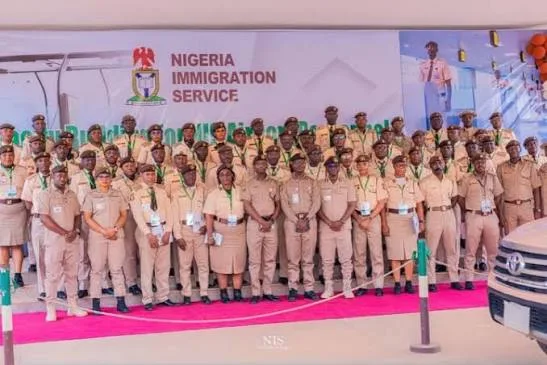

The Nigeria Immigration Service has pledged to address shortcomings in its visa and residency reforms following a stakeholders’ assessment of the programme, one year after its introduction.
The Comptroller-General of the NIS, Kemi Nandap, gave the assurance on Tuesday in Abuja during a one-day stakeholders’ sensitisation workshop on the reforms.
Also read: Lagos Seeks Investors to Unlock $50bn Climate Projects
The Nigerian Army also promised to strengthen its collaboration with the Immigration Service to secure the country’s borders, particularly areas vulnerable to illegal crossings.
The Chief of Civil-Military Affairs of the Army, Major General Musa Etsu-Ndagi, who represented the Chief of Army Staff, said the military would continue supporting immigration officers in monitoring the country’s frontiers.
He noted that Nigeria shares a land border of 4,047 kilometres, with significant portions remaining porous.
“The Nigerian Army will continue to support the NIS in manning the borders, especially in those areas,” he said.

Nandap, who was represented by the Deputy Comptroller-General in charge of Visa and Residency, Dr Franca Usiwoma Nwanneka, said the assessment provided an opportunity to examine achievements and identify areas requiring urgent attention.
She acknowledged that some applicants had encountered difficulties using the new system, including payment challenges, technical problems and other issues with the online portal.
According to her, the Service was prepared to listen to complaints and consider recommendations that could improve its operations.
The workshop, themed “Assessing the Implementation of the Nigeria Visa and Residency Reforms: Stakeholders’ Engagement and Strategies for Improved Service Delivery,” focused on evaluating progress, discussing implementation challenges and developing strategies for better service delivery.
Nandap explained that the reforms were introduced to replace some of the difficulties associated with manual immigration procedures, reduce delays, improve transparency, strengthen national security and make services more accessible.
Among the major changes was the introduction of the electronic visa system, which became operational on May 1, 2025, replacing the traditional Visa-on-Arrival arrangement.

She said applicants could receive decisions on their visa applications within 48 hours, provided they met the necessary requirements and passed security checks.
The system, she added, had improved transparency, reduced unnecessary human interference and strengthened the monitoring of visa applications and approvals.
The Immigration Service also introduced the F9A and F9B visa categories for adult and minor Nigerians returning to the country with foreign passports, respectively.
Nandap said the categories were designed to address the needs of Nigerians in the diaspora who found themselves in such circumstances.
On temporary employment permits, she said the Electronic Temporary Work Permit became operational on August 1, 2025, replacing manual processes that sometimes caused delays.
She noted that biometric capturing equipment had improved applicants’ identification and verification, while insurance requirements were introduced to strengthen the management of foreign nationals undertaking temporary work in Nigeria.
The electronic work permit is also connected to the Service’s border management system through the Landing and Exit Card facility, which is intended to help monitor foreign nationals and ensure compliance with the conditions of their stay.
Another major component is the electronic Comprehensive Expatriate Residence Permit and Automated Card, which also took effect on August 1, 2025.
According to Nandap, the platform has improved the processing of residence permit applications, renewals and status regularisation.
It also introduced the Investors Residence Permit as part of efforts to support the Federal Government’s drive to attract investment into the country.
She said integrating the electronic residence permit system with border management infrastructure would make it easier to verify expatriates’ immigration status at entry and exit points.
The Comptroller-General stressed that the success of the reforms depended on cooperation among government institutions and other stakeholders.
She called for continued support from relevant ministries, departments and agencies, the Ministry of Foreign Affairs, Nigerian diplomatic missions, security agencies, private-sector operators, international organisations and employers of expatriates.
Also read: Lagos Seeks Investors to Unlock $50bn Climate Projects
Nandap urged participants to contribute practical recommendations, saying the Service’s objective was to establish an immigration system that delivers efficient services, protects national security and supports Nigeria’s economic development.

Peculiar Adirika is a journalist and contributor to Freelanews.com, covering news, business, and public affairs.