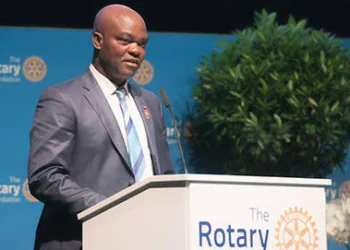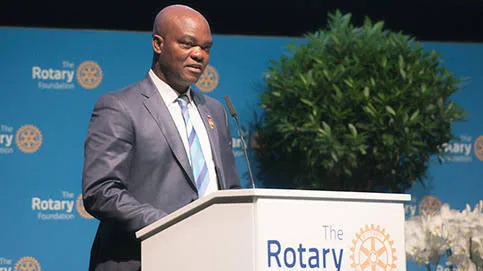

Rotary International President Olayinka Hakeem Babalola has outlined an ambitious vision for Rotary in Africa, targeting 100,000 members and 30 districts across the continent within the next three years.
The goal reflects Babalola’s long-standing interest in strengthening Rotary’s membership base in Africa and expanding the organisation’s capacity to serve communities through humanitarian projects, professional networks and community development initiatives.
Also read: Miranda announces 50th birthday celebration
Babalola, a Nigerian member of the Rotary Club of Trans Amadi in Rivers State, became Rotary International president for the 2026-27 year on July 1, 2026.
He is the third African to occupy the position, following the late Sam Owori of Uganda.
His proposed membership target builds on years of expansion across the continent.
According to a Rotary International account of Babalola’s leadership journey, Africa had approximately 29,000 Rotary members when he and Owori discussed plans to grow the organisation’s presence.

The figure has since increased to about 48,000.
The growth represents a significant expansion, although reaching 100,000 members would require the continent to more than double its current membership.
Babalola has earned a reputation within Rotary for his focus on membership development.
A Rotary International feature quoted Virginia Major, a past district governor from Port Harcourt, describing him as a leader who consistently challenges members to pursue specific growth targets.
The feature also highlighted his involvement in membership expansion during his earlier leadership roles, including his time as a club president and district governor.
For Babalola, the ambition goes beyond increasing membership figures.
In his September 2026 message published by Rotary District 5970, he said Rotary was fundamentally about people rather than projects or numbers.
He also referred to Rotary’s wider goal of reaching 1.25 million Rotarians and 125,000 Rotaractors by its 125th anniversary in 2030.
He encouraged clubs to examine their previous performance, improve member retention and share personal stories about the value of belonging to the organisation.
His emphasis on member engagement reflects a challenge facing membership organisations: attracting new participants while ensuring existing members remain active and connected.
Babalola has also spoken about the importance of bringing younger people into Rotary through Rotaract, the organisation’s programme for young professionals and students.
In an interview published by The Week in October 2026, he acknowledged that the transition from Rotaract into full Rotary membership had not been sufficiently effective globally, while noting that Africa and India had made progress in this area.
He also highlighted the importance of public-facing activities that allow young people to understand Rotary’s work and opportunities for involvement.
Beyond membership expansion, Babalola’s presidency carries a broader emphasis on peacebuilding and sustainable community impact.
When announcing his appointment, Rotary International said his priorities included strengthening the organisation’s contribution to peace and supporting community-led solutions to local and global challenges.
His presidential message for the 2026-27 Rotary year is “Create Lasting Impact”.
He has encouraged members to consider how activities such as improving access to clean water, promoting literacy and expanding healthcare can contribute to more peaceful communities.
Rotary’s work in Africa already covers several areas, including disease prevention, maternal and child health, education, water and sanitation, and economic development.
Its Nigerian maternal and child health initiative, Together for Healthy Families, is one example of how Rotary clubs and international partners have supported programmes addressing healthcare needs.
The proposed target of 30 districts and 100,000 members therefore places organisational expansion alongside the wider question of how Rotary can mobilise more people and resources for community service.

Achieving the ambition will require sustained recruitment, stronger clubs, effective leadership development and improved retention across different African countries.
It will also require cooperation among existing and incoming district leaders, clubs and Rotaract networks.
Babalola’s three-year vision sets a clear growth ambition for Rotary in Africa.
Also read: Miranda announces 50th birthday celebration
Its eventual success will depend not only on the number of people recruited or districts established, but also on the organisation’s ability to keep members engaged and translate its expanding reach into lasting service.

Mariam Balogun is a contributor to Freelanews.com, covering news, business, and public affairs.