
The FG ASUU agreement sparks cautious hope, but stakeholders say faithful implementation is key to ending university strikes in Nigeria
You can’t believe this, but it is the truth, uncomfortable and damning as it is: Since the return to civilian rule in 1999 (many argue we yet do not have democracy properly so-called), the Academic Staff Union of Nigerian Universities (ASUU) has embarked on strike actions totalling over 57 months.
Also read: Government offers positive 40% rise in ASUU salary talks
Almost five years lost by students and their parents especially to strike actions, since the lecturers and other university workers always return to hold government by the jugular and get paid for work not done!
Last Wednesday, I was guest of the Abeokuta-based Rock City 101.9 FM radio station where my professional colleague, comrade, brother and friend, Niran Malaolu, calls the shots and the discussion centred around whether the just-announced FG-ASUU agreement can signal the end of industrial actions, better known as strike actions, in our universities.
I was particularly impressed by the way a fellow discussant described the cankerworm of industrial actions that have debased university education as it has also reduced the universities to a ghost of their former selves not as “strikes” but “struggles” against the determined efforts – for selfish and asinine reasons – by the authorities to make a mockery of universities and university education here in Nigeria.
And my mind travelled back to 1978 when I was a Sixth Form (Higher School Certificate) student at Ilesa Grammar School.
That was the year of the historic struggle of university students, led by the patriotic, courageous, and bold Segun Okeowo, president of the National Union of Nigerian Students (NUNS), against the commercialisation of education by the Gen. Olusegun Obasanjo military junta, with Col. Ahmadu Ali as his Federal Commissioner of Education, as they were then called.
That gave the struggle its “Ali Must Go” battle and rallying cry. I recall that a student union leader from the then University of Ife (now Obafemi Awolowo University), Ile-Ife stormed Ilesha to conscientize and sensitize students.
The school authorities threw him out and shut the gates, but some of us had already received the message. We jumped the fence and teamed up with him to storm other schools in the town to rally students against the Obasanjo government’s anti-university education policies.
A few months later, I gained admission into the same University of Ife and experienced, first hand, the obnoxious policies of the Obasanjo administration that NUNS was protesting against.
Nothing hurts better than when it hits you in the stomach. Feeding costs, jacked upward, forced indigent students to adopt all manner of rationalization to survive: 0-1-1; 1-0-1; 0-0-1, etc.
Students died in the “Ali Must Go” struggle. Many student union leaders, including Okeowo, were rusticated. Conscientious lecturers who sided with the students were booted out of their jobs.
Vice-chancellors who raised an eye-brow about the military junta’s high-handedness were victimised. NUNS was banned, leading to the formation of NANS (National Association of Nigerian Students) to replace it.
That was the beginning of the downward slide in the fortunes of our universities and university education in Nigeria.
The licensing of private universities have helped to make matters worse. Many of Nigeria’s big cats now own private universities and it is no longer in their selfish interest to adequately fund and maintain public universities.
Those of our leaders who do not own private universities have the private universities of their friends and members of their political class to send their children to.
To their collective and individual shamelessness, our leaders prefer to send their children to Ivy League foreign universities and flaunt it to our face.
It is an open secret that the funds for this are usually pilfered from the common till. Today, education tourism accounts for one of the gaping holes draining the country of hard-earned and much-needed foreign exchange.
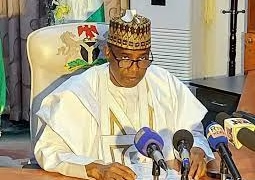
And so, the struggle continues! But is victory certain? I listened to ASUU president, Professor Chris Piwuna, celebrate the new agreement between the Federal Government and ASUU with mixed feelings.


It is a step forward that we have an agreement at all. There was a time when the government even denied – bold-face denial, as it is called! – that there was an agreement between it and ASUU!
As if we were not all here when President Goodluck Jonathan climbed down from his high horse to insist that the incessant brickbat and back-and-forth between the FG and ASUU must end by adopting the system the Catholics have perfected in choosing a new pope.
Jonathan locked himself up with all the parties until an agreement was reached. That was how the 2009 FG-ASUU agreement was birthed, but which the government of President Muhammadu Buhari truncated.
The longest ASUU struggle was recorded under Buhari – a scandalous 628 days, by one account!
Will President Bola Ahmed Tinubu be different from his predecessor? Or will the new FG-ASUU agreement suffer the same fate as the one before it? I went round the Ivory Tower to pick the brains of those who ought to know.
For obvious reasons, I will cover the commentators with the cloak of anonymity. Read on:
1. “There have been an uncountable number of agreements between the FG and ASUU which were not implemented.
Thus, the new agreement will soon become part of the unimplemented agreements of the past and, then, another threat of ASUU strike will start all over again!
Moreover, in this era of bribery and corruption, ASUU might have been offered some dough to sign the new agreement.
Also, should ASUU persist in going on another strike, it could end up being divided by the Tinubu administration into two or more factions.”
2. “It is important to distinguish between the signing of an agreement and its faithful implementation. While the conclusion of an agreement is a necessary step, implementation remains the true test of its effectiveness.
Therefore, whether the recent ASUU-FG agreement will permanently end strikes in the university system must be approached with cautious realism.
The landscape of academic unionism in Nigeria has evolved. ASUU no longer represents all academic staff in the university system.
Other registered academic unions now exist, many of which are fundamentally opposed to incessant strike actions because of the demonstrable harm such disruptions inflict on students, institutions, and the broader education system.
Consequently, any future consideration of strike action by any single union will inevitably be shaped by this new plural environment.
The emergence of CONUA and NAMDA introduces additional institutional constraints that make routine, system-wide strikes increasingly difficult to sustain.
Beyond union dynamics, the most decisive factor remains government conduct. Consistent, timely, and good-faith implementation of agreements with all registered unions, academic and non-academic alike, will significantly reduce the triggers for industrial disputes.
Equally important is a proactive governance posture that addresses emerging grievances before they escalate into crises.
In this sense, it is not the signing of an agreement with any single union that will, by itself, stem the tide of strikes.
Rather, lasting industrial peace will depend on a combination of faithful implementation, inclusive engagement with all registered unions, and a proactive approach by the government to manage systemic challenges within the university sector.
The responsibility for creating an environment largely free of disruptive industrial actions therefore rests, in substantial measure, with the Federal Government.”
3. “The new agreement between FG and ASUU would have put an end to strikes and unrest in our universities if the FG is sincere enough to adhere to the contents of the agreement.
The crisis took a long time to end due to the insincerity of the FG, which has been appointing various types of people into the negotiating committees. Some of them had no respect for academics.
Look at the way the Babalakin Committee goofed! Members of the government side in the committee at times were stumbling blocks.
A case-study is that of Ngige who was supposed to be an arbiter (but who became) another fighter.
Adama Adamu whose house was on fire was sleeping and dreaming outside! ASUU has no problem adhering to agreements, having given this government over two years of industrial harmony. It is when the government fails that warriors return to the battle front.
Secondly, the division among the unions in the education sector caused by the government will make any peace achieved now look like peace of the graveyard.
Unions in our universities seem not to trust one another. One needs to appreciate Professor Piwuna, ASUU president, for advising the FG to quickly conclude negotiations with sister unions for a peaceful university environment.
Even at that, this has not quenched the fire of distrust amongst our unions. Each union has its peculiarities pertaining to emoluments and allowances.
A situation whereby some unions want to have what belongs to other unions (will not augur well for peace).
Each union should be given what it rightly deserves. Thirdly, the government should put more effort into making our universities what they used to be 40 years ago.
This can be achieved through appropriate funding and investment in various sectors of our disciplines. No course in the university is useless.
There is what we call ‘town and gown’ interaction between the university and the outside world. This is what we call community service.
There are many ways to rescue our universities from infrastructural, moral, and ethical decadence.”
5. “The 2025 ASUU-FGN agreement is duly acknowledged as a significant development in the ongoing effort to stabilise the university system.
However, it is important to note that the terrain of academic unionism in Nigeria has evolved from a monopoly to a plural system, following the lawful registration of other academic unions, including CONUA and NAMDA.
For justice to be seen to be done and for peace to be durable, negotiations with all registered academic unions should be concluded alongside that of ASUU.
An inclusive approach will strengthen confidence in the process and contribute more meaningfully to lasting stability in our universities. Beyond agreements, a critical factor is implementation.
One expects the Federal Government to reduce the existing trust deficit by faithfully implementing the terms of the agreement voluntarily and in good faith, rather than under compulsion or pressure.”
6. “The ASUU-FG agreement is not likely to bring an end to strikes. Firstly, there is no agreement that gets implemented without strikes to goad the government into action.
Secondly, are the remunerations at par with the African average? Far from it! Is it because FG does not have the money? No! It is the lack of the will to prioritize education.
Apart from remunerations, facilities for training are not available. In addition, Governing Councils will have to contend with internal strikes because some universities may not have the capacity to pay the ones allotted to them.”
A Chinese proverb says the journey of a thousand miles starts with the very first step taken. Personally, that is how I view the new FG-ASUU agreement.
ASUU is just one of the variables in a complex mix involving ASUU, CONUA, NAMDA, non-academic staff unions (both junior and senior), other recognised unions in the university system, not least of all the students’ union government.
Also read: ASUU president Piwuna praises Tinubu in controversial remark
University administrators are also a key player in whether or not industrial peace will reign in our university campuses. These and many other variables will be examined when we return next week.