

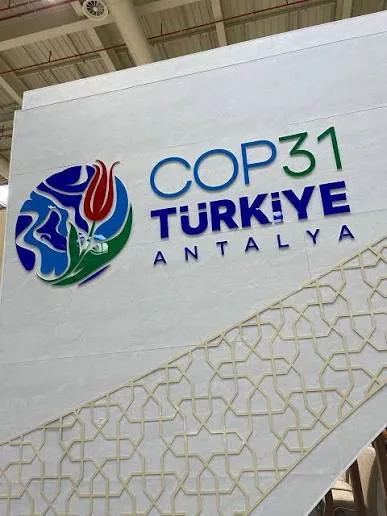

The Federal Government and the United Nations have expressed disappointment after the 31st United Nations Climate Change Conference (COP31) ended in Antalya, Türkiye, without a comprehensive agreement.
The negotiations collapsed on Sunday after nearly 200 countries failed to reach consensus, despite almost 50 hours of additional discussions beyond the scheduled closing time.
Also read: Ogunbote blames poor finishing for Plateau United draw
Nigeria, however, has vowed to continue implementing its domestic climate programmes and commitments under the Paris Agreement.
The Director-General of the National Council on Climate Change, Omotenioye Majekodunmi, said the failure to secure a final political agreement was disappointing but would not weaken the country’s determination to tackle climate change.
In a statement released on Sunday, she said Nigeria would sustain the implementation of its Nationally Determined Contribution 3.0, strengthen climate governance and attract investment into the country’s energy transition.
Majekodunmi noted that the absence of a new agreement did not invalidate existing international commitments or reduce the urgency of climate action.

She added that the negotiations had highlighted the need to match climate ambitions with adequate funding and practical implementation strategies, particularly for developing countries facing different economic realities.
According to her, Nigeria would assess its climate progress through its effects on employment, businesses, access to energy and people’s livelihoods.
COP31, which opened on November 9 and was scheduled to conclude on November 20, eventually ended on Sunday without adopting a final decision.
The breakdown exposed deep divisions among participating countries over the phase-out of fossil fuels, climate financing, adaptation support and the transition to cleaner energy.
The summit also became the longest United Nations climate conference on record, exceeding the previous record set by COP25 in Madrid, Spain, in 2019, which continued for approximately 44 hours beyond its scheduled closing.
COP31 President Murat Kurum confirmed during the closing plenary that the proposed final agreement would not be adopted after countries failed to resolve their differences.
He criticised the inability of participants to move beyond disagreements over specific wording, warning that the failure to make decisions undermined public expectations.
Australia’s Climate Minister and COP31 negotiations chair, Chris Bowen, also acknowledged that efforts to broker an agreement had failed.
Bowen said nearly 200 countries remained divided by what he described as unbridgeable red lines, leaving the negotiations without a common political outcome.
One of the major disagreements concerned whether the final text should contain a clear commitment to transitioning away from fossil fuels.
Countries also disagreed over adaptation financing and the role of carbon capture technology in addressing climate change.
The failure attracted criticism from United Nations Secretary-General António Guterres, who said he shared the frustration of those who expected governments to deliver a stronger response to the climate crisis.
Guterres warned that the absence of an agreement would not change the scientific evidence of worsening global temperatures, intensifying extreme weather events and dangerously high greenhouse gas emissions.
He also criticised continued dependence on coal, oil and gas, arguing that fossil fuels were worsening climate instability, exposing economies to price shocks and threatening energy security.
United Nations climate chief Simon Stiell similarly described the progress made during the negotiations as limited, warning that the world could not afford another failed summit.
Climate financing was another major obstacle, particularly after the proposed target of $120bn for adaptation funding disappeared from the final draft.
Countries failed to agree on a concrete strategy for mobilising the financial resources needed to support vulnerable economies facing the effects of climate change.
Attention has now shifted to COP32, scheduled to take place in Addis Ababa, Ethiopia, next year, where governments are expected to revisit the unresolved commitments.

The setback follows the COP28 agreement in Dubai in 2023, where countries committed to transitioning away from fossil fuels in a just, orderly and equitable manner.
At COP30 in Belém, Brazil, governments also provided a mandate for developing a just transition mechanism, raising expectations that the Antalya conference would establish stronger institutional support for the process.
Also read: Ogunbote blames poor finishing for Plateau United draw
However, the Climate Action Network maintained that the campaign for climate justice would continue, urging governments to ensure that the next summit delivers adequate financing, adaptation support and a fair energy transition for developing countries.

Peculiar Adirika is a journalist and contributor to Freelanews.com, covering news, business, and public affairs.