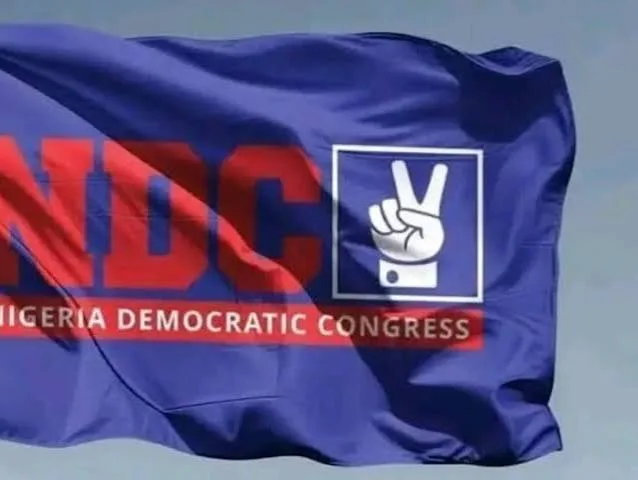

The Deputy National Publicity Secretary of the Nigeria Democratic Congress, Abdulmumin Abdulsalami, has resigned from the party, accusing influential officials of injustice, exclusion and interference in its affairs.
Abdulsalami announced his decision in a letter addressed to the National Chairman, Senator Moses Cleopas, through his former ward chairman in Nagazi Ward, Adavi Local Government Area of Kogi State.
Also read: NESG says grassroots sports can boost jobs, economic growth
In the letter, titled “Letter of Resignation from the Nigeria Democratic Congress: Withdrawal from All Partisan Commitments to the Party”, he said he was leaving after concluding that his contributions to the party conflicted with the interests of some influential members.
The former party official described himself as a foundation member and a key figure in its formative period, but alleged that powerful officers had frustrated his efforts.
“As a foundation member of the NDC, ditto a critical formative leader in the party, I am compelled to voluntarily take the exit having realised that my sincere and positive contributions to the meteoric rise and success of the party are at odds with the vested interests of a few powerful officers who call the shots.
“More so, this painstaking decision serves my best interest as I prioritise my peace of mind rather than recurrent complaints at the sight of a series of injustices meted out to me,” he stated.

Abdulsalami previously served as the NDC Protem Chairman in Kogi State before taking up national responsibilities, including the position of Deputy National Publicity Secretary and, later, Deputy National Director for Labour and Civil Society.
He thanked the party’s National Leader, Senator Henry Dickson, for the opportunities he had received and acknowledged the support of colleagues, civil society activists and media practitioners who worked with him during the party’s early development.
Speaking to *The PUNCH* about his next political move, Abdulsalami said he intended to return to private life rather than remain in an organisation where he felt excluded.
“I am calling it quits and heading back home to avoid orchestrated melodrama of exclusion from party affairs. I love you all, but I love myself and my mental sanity most,” he said.
He declined, however, to identify the party officials he accused of frustrating his contributions.
An unnamed party insider, who spoke to the newspaper because of the sensitivity of the matter, described the resignation as the outcome of a troubled relationship between Abdulsalami and the party leadership.
The source alleged that Abdulsalami had worked for the party without receiving a salary or an operational budget and was gradually sidelined from the National Working Committee despite being a founding member.
“Abdul’s case is really a sad one. He has survived what I can call a toxic relationship. Despite all his efforts since the start of this NDC, he has never been paid a dime as salary or a working budget.
“Secondly, he was subtly eased out of the National Working Committee despite being a foundational member by high-ranking leaders of the party. His leaving the party, to many of us, is the only choice,” the source said.
The insider added that Abdulsalami had considered leaving since October but was persuaded to remain by the party’s national leader.
The NDC National Publicity Secretary, Osa Director, however, dismissed suggestions that the resignation reflected internal divisions within the party.
“There is no internal wrangling in the party. The exit of one person is not enough to conclude, especially as we also witness influx of a lot of people into the party every day,” he said.
Abdulsalami’s departure comes amid disagreements over the organisation and control of the NDC following the entry of former Labour Party presidential candidate Peter Obi and former Kano State Governor Rabiu Musa Kwankwaso.

The two politicians formally joined the party on May 3, 2026, after leaving the African Democratic Congress. The NDC, however, already had an established political structure before their arrival.
In June, the party’s National Chairman, Cleopas Moses, said it had structures across the 36 states and the Federal Capital Territory before Obi and Kwankwaso joined.
He acknowledged that their entry had added value to the party but maintained that its existing structures were already in place.
Tensions subsequently emerged between the party and the political movement associated with the two politicians.
About two months ago, the NDC clashed with the Obi-Kwankwaso Movement, popularly known as the OK Movement, after the group rejected calls for its structures to be integrated into the party.
The movement’s Director-General, John Ughulu, insisted that it would not surrender its national, state, local government and ward structures to the NDC or any other organisation.
Dickson, a former Bayelsa State governor, argued that political movements should complement political parties rather than compete with them or maintain parallel structures.
He also criticised the movement’s decision to establish a presidential campaign council, describing it as “unheard of” and “nonsensical”.
Ughulu maintained that the OK Movement was an independent political organisation rather than a conventional support group.
The disagreements within Obi’s political camp were followed by another development on Wednesday, when Yunusa Tanko, Obi’s former Political Adviser for Northern Nigeria and immediate past National Coordinator of the Obidient Movement, was unveiled as National Coordinator of the Social Democratic Party Presidential Campaign Council.
Tanko’s appointment came less than two weeks after he resigned as Obi’s political adviser.
He announced his departure from Obi’s political team on October 30, 2026, saying he was returning to the National Consultative Front, where he serves as co-chairman.
He later disclosed that he had formally resigned his appointment with Obi before accepting the SDP role.
Tanko played a prominent part in Obi’s 2023 presidential campaign and the mobilisation of supporters through the Obidient Movement.
His departure from Obi’s political team, although not from the NDC, followed the earlier exit of another Obi supporter, Nana Kazaure, who joined the campaign team of former Vice-President Atiku Abubakar.
Also read: NESG says grassroots sports can boost jobs, economic growth
The developments come as the NDC works to consolidate its structures and mobilise support ahead of the 2027 general elections.

Mariam Balogun is a contributor to Freelanews.com, covering news, business, and public affairs.