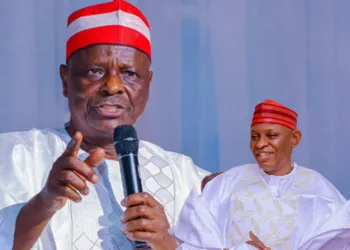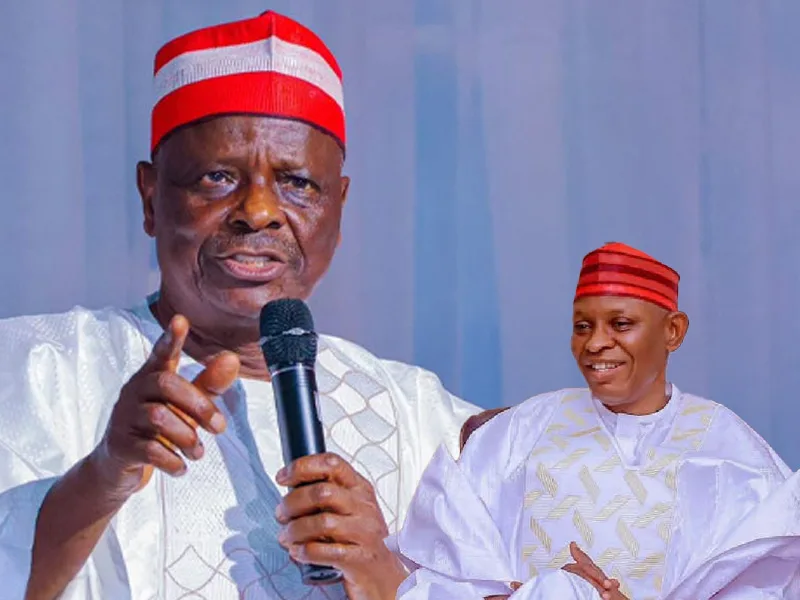

Former Kano State Governor and leader of the Kwankwasiyya movement, Rabiu Musa Kwankwaso, has accused Kano State Governor Abba Kabir Yusuf of allegedly using anti-corruption institutions and proxy organisations to tarnish his reputation and weaken his political influence ahead of the 2027 general elections in Nigeria.
Kwankwaso made the allegations in a statement published on his official Facebook page on Friday, 27 November 2026, expressing concern over the deterioration of his relationship with Yusuf and what he described as attempts to turn government institutions into instruments of political persecution.
Also read: Adesua Etomi celebrates as cancer test returns negative
The former governor alleged that the incumbent governor was determined to drag him and members of his family into public controversy through investigations and accusations involving the Economic and Financial Crimes Commission (EFCC).
He maintained that the alleged actions were intended to damage a reputation he had built over several decades in public service and undermine the political strength of the Kwankwasiyya movement.
Reflecting on his longstanding relationship with Yusuf, Kwankwaso recalled that the governor had previously served under him in several capacities, including Personal Assistant, Principal Private Secretary and Commissioner.
He also noted that Yusuf emerged as the Kwankwasiyya movement’s governorship candidate in the 2019 and 2023 elections, describing the political relationship as one built on years of trust and loyalty.

However, Kwankwaso expressed disappointment over what he considered a betrayal of that relationship, alleging that the confidence he had placed in Yusuf had been “misused and abused”.
The former governor further claimed that Yusuf had earlier submitted a formal request to the EFCC seeking an investigation against him but failed to secure the outcome he allegedly wanted because of the commission’s established procedures.
According to Kwankwaso, the governor subsequently turned to the Society for Anti-Corruption and Good Governance Initiative (SACGGI), which recently submitted a petition to the anti-graft agency concerning assets allegedly linked to him.
“We believe that some months ago the Governor personally submitted a formal request to the EFCC seeking to come after me. After failing to compel the Commission, owing to its institutional integrity and established procedures, he resorted to a little-known body called the Society for Anti-Corruption and Good Governance Initiative (SACGGI),” Kwankwaso said.
He also alleged that information relating to the complaints was being selectively leaked to media organisations and amplified across public platforms to create a negative impression about him.
Kwankwaso argued that the alleged campaign went beyond personal attacks, describing it as an attempt to weaken the political structure he had built and reduce the movement’s chances of performing strongly in the 2027 elections.
He expressed concern that the situation could affect other prominent members of his political camp, including Kano governorship aspirant Comrade Aminu Abdussalam, who is reportedly involved in legal and electoral processes concerning his candidacy.
The former governor suggested that the growing political disagreements could create unnecessary tension in Kano, particularly as political activities gradually intensify ahead of the next general elections.
He warned that the use of public institutions for partisan purposes could undermine democratic confidence and potentially threaten peace and security in the state.
Despite his criticism of the alleged political interference, Kwankwaso commended the EFCC for what he described as its professionalism and impartiality.
He recalled previous invitations extended to him by the commission during his years in public service, maintaining that he had no objection to legitimate investigations conducted in accordance with established legal procedures.
The former governor also defended his public service record, pointing to his experience as governor, minister and senator as evidence of his longstanding involvement in Nigeria’s political and administrative affairs.
He urged politicians and public office holders to exercise restraint, reminding them that political authority and government positions were temporary.
Kwankwaso further called on political actors to respect the independence of democratic institutions and avoid actions capable of weakening public confidence in agencies established to promote accountability.

The disagreement comes against the background of a significant political relationship between Kwankwaso and Yusuf, whose rise to the Kano governorship was closely associated with the Kwankwasiyya political movement.
The movement, recognised by its distinctive red caps and strong grassroots following, has remained an influential political force in Kano State and the wider North-West region.
Yusuf’s emergence as governor in 2023 represented an important political achievement for the movement, following his earlier unsuccessful attempt in 2019.
However, the latest accusations suggest that relations between the two political figures have deteriorated considerably, raising questions about the future of their political alliance and its implications for the next electoral cycle.
The EFCC petition involving SACGGI has also introduced a new dimension to the disagreement, particularly regarding the distinction between legitimate anti-corruption investigations and allegations of politically motivated complaints.
At the time of Kwankwaso’s statement, the allegations against Governor Yusuf had not been independently established, and no response from the governor was included in the account.
The existence of a petition to the EFCC should also not be interpreted as proof of wrongdoing by the former governor.
With the 2027 elections approaching, the dispute could become an important test of political unity within Kano’s ruling political structure.
Also read: Adesua Etomi celebrates as cancer test returns negative
For now, Kwankwaso’s central message is that democratic institutions must remain independent of political rivalries and that disagreements among political leaders should not come at the expense of public confidence, stability and peaceful political participation.

Mariam Balogun is a contributor to Freelanews.com, covering news, business, and public affairs.