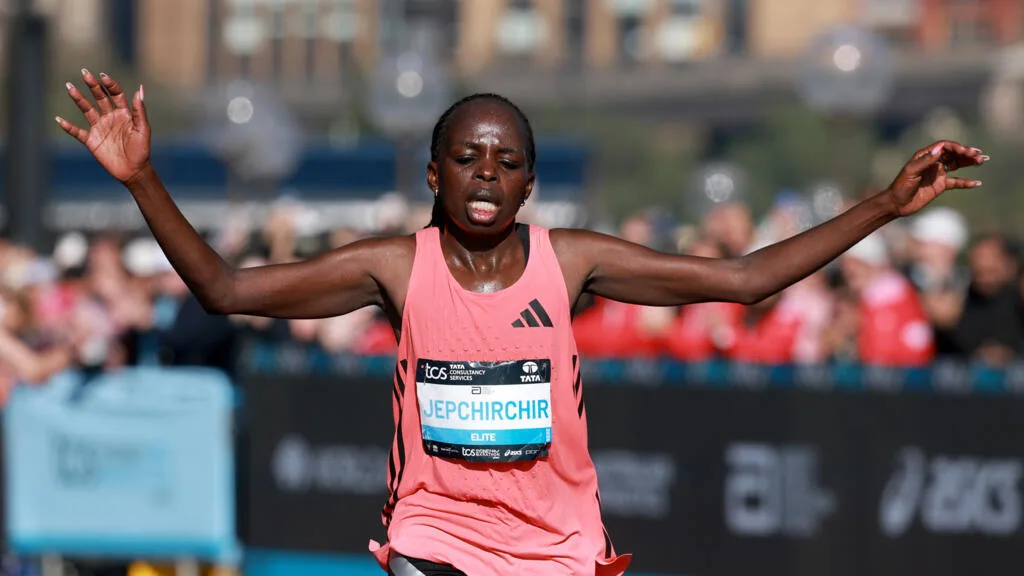

Kenyan marathon star Peres Jepchirchir has been handed a three-year ban for doping after an out-of-competition sample revealed traces of the banned substance erythropoietin (EPO), the Athletics Integrity Unit (AIU) announced on Thursday, November 19, 2026.
The 33-year-old reigning marathon world champion, who won Olympic gold at the Tokyo 2020 Games held in 2021, was given a full suspension effective from October 20, according to the AIU.
Also read: NIS moves to stop unapproved sports coaching courses
The sample was collected in Kenya before Jepchirchir’s victory at the Sydney Marathon in August, adding a major setback to the career of one of the country’s most decorated distance runners.
Jepchirchir’s achievements include four World Marathon Majors titles, with victories at the New York Marathon in 2021, Boston Marathon in 2022 and London Marathon in 2024.
She was also a former world record-holder in the half-marathon.
Two other Kenyan athletes were sanctioned in separate doping cases. Veronica Loleo, who won silver in the half-marathon at the 2026 World Road Running Championships, received a three-year ban for the same offence.

Ronald Korir, who finished fourth at the 2023 Berlin Marathon, was handed a six-year suspension after failing to explain irregularities identified in his Athlete Biological Passport.
The latest sanctions add to a growing list of Kenyan athletes suspended or banned by the AIU since 2017.
More than 140 athletes from the East African country, including women’s marathon world record-holder Ruth Chepngetich, have faced disciplinary action over doping violations.
AIU chief executive Brett Clothier acknowledged progress made by Kenyan authorities but warned that further efforts were needed to address the problem.
“The Kenyan authorities have made a lot of progress in the fight against doping in the last five years, but these cases highlight that there is still a long way to go,” Clothier said in a statement.
He added that the Kenyan government had committed to strengthening the Anti-Doping Agency of Kenya and tackling criminal networks allegedly facilitating doping in the country.

The AIU said Jepchirchir’s case comes at a critical time for Kenyan athletics, particularly as Nairobi prepares to host the 2029 World Athletics Championships.
Kenya also hosted a three-day visit by the World Anti-Doping Agency (WADA) last month, during which its president, Witold Banka, urged the country to adopt a zero-tolerance approach to doping.
“Kenya proudly calls itself the Home of Champions. But for that home to remain respected and credible, it must also be clean,” Banka said.
Also read: NIS moves to stop unapproved sports coaching courses
The latest cases have renewed attention on the country’s anti-doping efforts and the need to protect the credibility of its international athletics reputation.

Mariam Balogun is a contributor to Freelanews.com, covering news, business, and public affairs.