
Wale Tinubu nation-building message urges Nigerians to embrace failure, resilience and collective action to drive national development
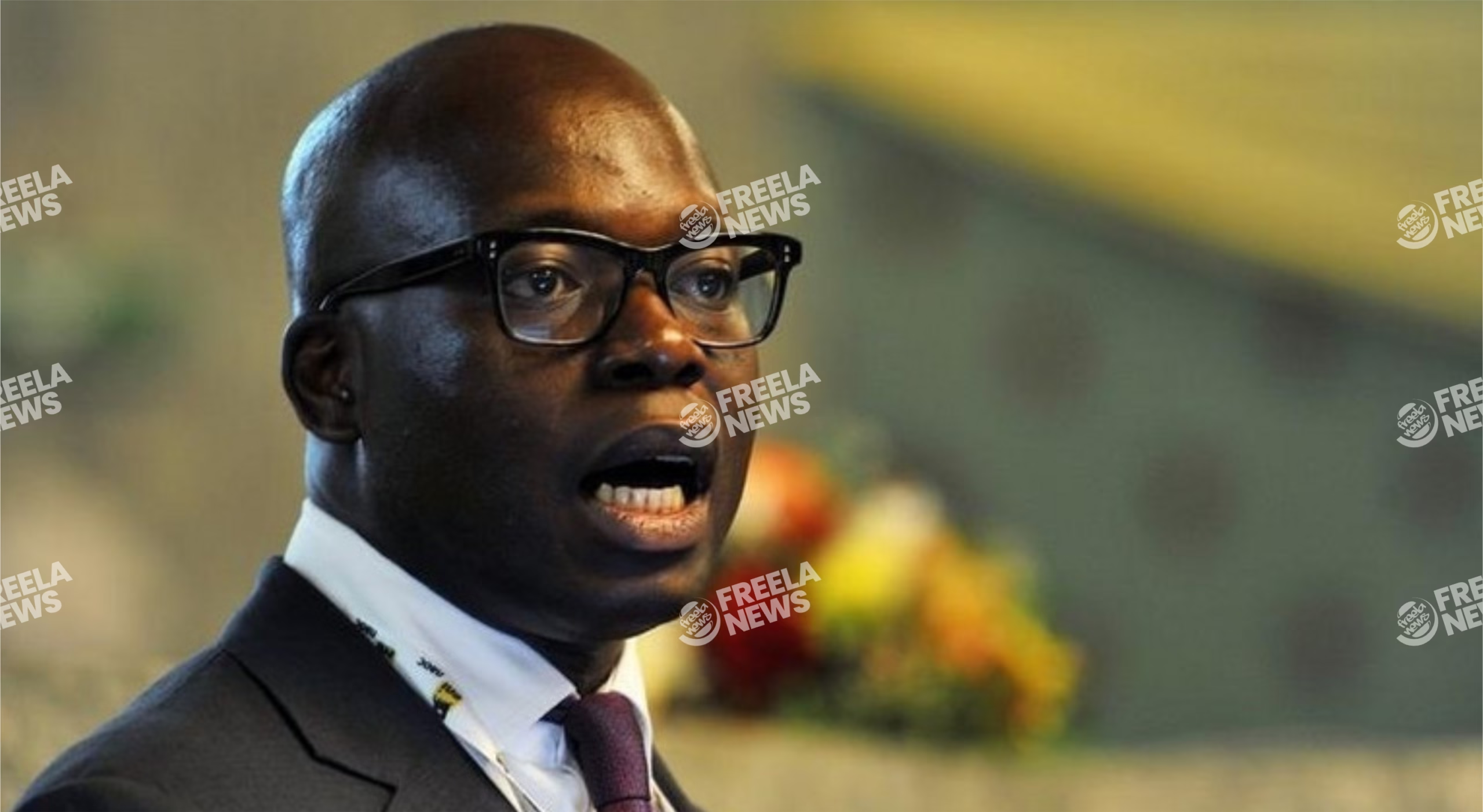
The Group Chief Executive Officer of Oando Plc, Wale Tinubu, on Friday delivered a compelling call for Nigerians to embrace failure as a necessary tool for national progress, arguing that sustainable development depends on resilience, shared belief and collective responsibility.
Also read: UNILAG awards honorary doctorate to Wale Tinubu
Wale Tinubu, speaking during an interview in Lagos shortly after the 56th convocation ceremony of the University of Lagos, said societies advance when citizens are willing to learn from setbacks rather than persistently condemn their country.
He said the core of nation-building lies in making failure an acceptable concept and extracting lessons that drive improvement.
The Oando chief executive maintained that Nigerians must abandon the assumption that the country is incapable of working and instead take ownership of making it succeed.
He said progress would only come when citizens stop seeing failure as final and begin to view it as part of a learning curve that strengthens institutions and people.
“We learn from our failures and we get it right. We stop condemning the country and believing the country cannot go right.
The country can go right, and it goes right by us as a people collectively moving in one direction,” Tinubu said.
The remarks were made after Tinubu, popularly known as J.A.T., was conferred with an honorary doctorate degree in Business by the University of Lagos in recognition of his contributions to enterprise building, energy sector transformation and national development.
He said success in business and in nation-building requires the courage to take risks, noting that fear of failure often prevents individuals and societies from making meaningful attempts.

Tinubu drew parallels with countries that achieved breakthroughs only after repeated failed efforts, describing persistence as a defining ingredient of progress.

He also called for deeper collaboration between the public and private sectors, particularly in education, health and other social services, saying sustainable development requires shared investment and accountability.
According to him, alumni engagement plays a critical role in strengthening educational institutions and ensuring continuity in development.
He said former students who have succeeded professionally must be deliberately re-engaged to contribute to the growth and stability of universities.
“This is a continuous process of reinvesting in what you have towards building a beneficial future,” he said.
Speaking earlier on behalf of other honourees at the convocation, Tinubu described the honorary award as a renewed call to service rather than a celebration of past achievements.
He said the University of Lagos, founded in 1962, was established on the understanding that political independence alone was insufficient without world-class institutions to support national growth.
Tinubu paid tribute to past and present leaders of the university, noting that the institution had produced individuals who shaped Nigeria across public service, law, science, enterprise, medicine, the arts and diplomacy.
He said the university had evolved into a hub for innovation, digital research, entrepreneurship and the creative economy, producing a new generation of problem-solvers.
“UNILAG has never been content to produce credentials but has produced nation-builders,” he said.
According to Tinubu, Nigeria is at a defining turning point, undergoing a difficult but necessary transition driven by reforms aimed at stabilising the economy, restoring confidence and unlocking productivity.
He stressed that reforms would only succeed when ideas shape action and knowledge guides leadership, adding that universities must play an active role in addressing national challenges.
“Citadels of learning generate the ideas, train the innovators, test the evidence, and nurture the ethical leadership that progress demands,” he said.
Tinubu also urged sustained prioritisation of education, arguing that countries that perform consistently invest heavily in learning, particularly at higher levels.
Reflecting on his personal journey, he said he grew up believing it was possible to dream beyond circumstances and build from scarcity.
He recalled how, as a young lawyer with limited resources, he learned to identify opportunity in crisis, a mindset that shaped his entrepreneurial path.
“Do not wait for perfect conditions. You have to move, you have to dare, and you have to build as you proceed,” he advised graduating students.
Born on June 25, 1967, Tinubu studied law at the University of Liverpool and the London School of Economics before being called to the Nigerian Bar in 1990.
He later co-founded Ocean and Oil Group, which evolved into Oando Plc, now one of sub-Saharan Africa’s leading integrated energy companies.
Also read: Wale Tinubu champions Africa Energy Agenda at Davos 2026
Beyond business, Tinubu has played significant roles in humanitarian response and education through the Oando Foundation and global policy engagements, earning him the national honour of Commander of the Order of the Niger in 2022.