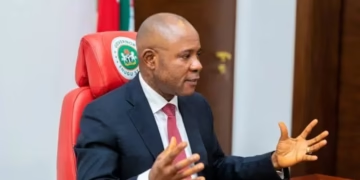


Accord Party presidential candidate Dr Gbenga Hashim has unveiled an ambitious Energy First policy, promising to give Nigerian refineries access to locally priced crude oil, expand domestic refining capacity and reduce petrol prices if elected in 2027.
Speaking during the Diaspora Dialogue in Ilorin, Kwara State, Hashim said Nigeria must stop treating crude oil primarily as an export commodity and instead use it as the foundation of industrial growth and economic transformation.
According to him, an Accord Party administration would introduce a strategic domestic crude pricing framework that would allow qualifying Nigerian refineries—including the Dangote Refinery—to purchase crude at a competitive local price rather than international market rates.
“Our crude is our strategic advantage. We will put that advantage behind Nigerian industry,” Hashim said.
He stressed that the proposed policy would not be designed to favour any single refinery, insisting that every Nigerian refinery meeting transparency, efficiency and performance standards would benefit from the same framework.


“This is not a Dangote subsidy. It is a Nigerian industrial strategy. Dangote will benefit because it has invested at extraordinary scale. Other existing refineries will benefit. New refineries will benefit,” he said.
Hashim said his administration would expand Nigeria’s refining capacity by an additional one million barrels per day within three years through direct government investment and strategic joint ventures.
He said the objective extends beyond fuel sufficiency to establishing Nigeria as Africa’s leading refining and petrochemical hub.
“We want Nigerian refineries supplying Africa. We want Nigerian petrochemical companies competing globally. We want Nigerian energy traders operating internationally,” he said.
The Accord Party candidate also proposed increasing Nigeria’s crude oil production to four million barrels per day within 24 months by recovering about 3,000 shut-in and non-producing oil wells, improving security and restoring production infrastructure.
Hashim maintained that his Energy First policy could reduce the pump price of petrol to about ₦605 per litre as an initial target, arguing that lower prices should come from increased production and refining rather than continuous fuel subsidies.
“₦605 is not our destination. It is a starting point in a transition from subsidising consumption to building productive capacity,” he said.
He added that the long-term ambition is to reduce petrol prices to between ₦200 and ₦300 per litre through higher crude production, expanded refining, improved efficiency and lower logistics costs.
According to Hashim, Nigeria’s energy future lies in creating value from crude oil through refined products, petrochemicals, fertilisers, lubricants and other industrial products rather than relying solely on crude exports.

He said an Accord Party government would support the development of an integrated energy ecosystem built around pipelines, storage facilities, ports, electricity, transportation infrastructure and predictable regulation.
“Government will build the ecosystem. Nigerian entrepreneurs will build the companies. Nigerian companies will conquer the markets,” Hashim said.
The presidential hopeful said the emergence of the Dangote Refinery has demonstrated that Nigerian capital can compete globally, adding that government’s responsibility is to provide the infrastructure and policy certainty needed for indigenous energy companies to thrive.
Hashim concluded that the Energy First policy is aimed at transforming Nigeria from a major crude exporter into a global energy powerhouse driven by local refining, industrialisation and internationally competitive Nigerian companies.

AbdulBasit Saba is a journalist and contributor to Freelanews.com, covering news, business, and public affairs.