
Uganda’s Minister of Energy and Mineral Development, Dr Monica Musenero Masanza, and Minister of State for Finance, Planning and Economic Development (Privatisation and Investment), Hajjat Amina Mukalazi, have invited Nigerian industrialist and President of Dangote Industries Limited, Aliko Dangote, to invest in the East African country’s proposed oil refinery, fertiliser and mineral-processing projects following a visit to his industrial facilities in Lagos, Nigeria, on Sunday, November 15, 2026.
The Ugandan delegation is seeking Dangote Group’s participation in a proposed 60,000-barrel-per-day refinery in Hoima, alongside opportunities in fertiliser blending, phosphate processing and salt manufacturing, as the government intensifies efforts to convert its natural resources into finished products, create employment and reduce reliance on imports.
Also read: FG unveils digital strategy to tackle teacher shortage
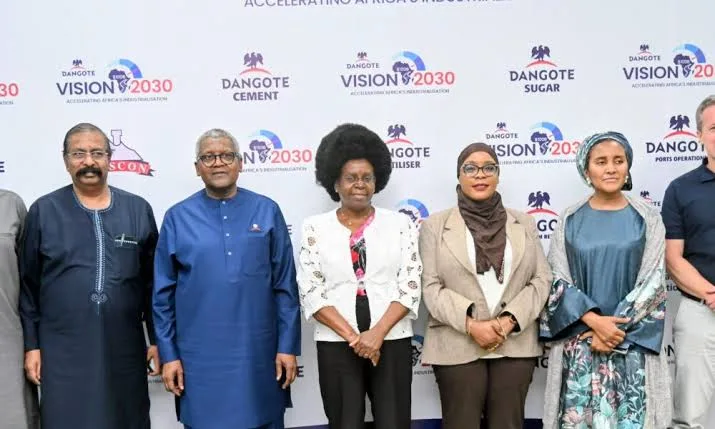
The investment pitch was presented during a tour of the Dangote Petroleum Refinery and Petrochemicals and Dangote Fertiliser Limited, where the visiting ministers met Dangote and senior executives of the conglomerate, including Group Vice President Devakumar Edwin and David Bird, Managing Director and Chief Executive of Dangote Petroleum Refinery and Petrochemicals.
According to a statement released after the visit, Mukalazi urged Dangote to take a leading role in Uganda’s planned refinery project, describing the proposed investment as an important part of the country’s industrial development ambitions.
She said Dangote Group’s experience in financing, constructing and operating large-scale industrial facilities could provide valuable technical and commercial expertise for Uganda’s plans.
“You have shown that an African company can build world-scale industry in Africa and run it by Africans themselves,” Mukalazi said.

The minister argued that Uganda could benefit from the group’s experience in developing integrated industrial facilities, particularly as the country seeks to establish stronger links between petroleum production, manufacturing and domestic distribution.
She also suggested that the proposed Ugandan refinery could complement Dangote’s planned investment in Lamu, Kenya, with the inland facility serving markets within Uganda and neighbouring landlocked countries while the coastal refinery caters to maritime and coastal markets.
Mukalazi acknowledged, however, that the investment estimates presented to Dangote would require further technical assessment by the company’s team before any firm decisions could be taken.
“Our crude, our phosphate, our salt are waiting to be turned into fuel, fertilisers and chemicals here in Africa and in Uganda by Africans,” she said.
She also invited Dangote to visit Uganda for further discussions, assuring the industrialist that the government was prepared to address regulatory and investment-related obstacles that could delay potential projects.
“Uganda needs Dangote, and now is the right time. Our country is ready and moving rapidly towards industrialisation,” Mukalazi added.
The minister said the proposed partnership could generate employment, encourage technology transfer and create opportunities for local suppliers, contractors and businesses, particularly among young Ugandans.
Musenero said the delegation’s visit was also intended to provide an opportunity to study the operations of Dangote’s industrial facilities and identify practical areas of cooperation in petroleum refining and fertiliser production.
She described fertiliser manufacturing as a particularly important opportunity, noting that Uganda possessed mineral resources suitable for producing agricultural inputs but had struggled to develop the industrial capacity required to process them into finished products.

Bird welcomed the delegation’s interest, describing the visit as evidence of Uganda’s commitment to industrial development and its willingness to explore partnerships with established African manufacturers.
“Uganda has incredible natural resources and human capital. As both ministers have expressed during this visit, there is also no shortage of ambition or political will to pursue industrialisation,” he said.
The proposed refinery is expected to process up to 60,000 barrels of crude oil daily at Kabaale in Hoima District, where Uganda’s major oil development activities are concentrated.
However, the latest approach to Dangote comes against the background of an existing arrangement with another investor.
According to the Uganda National Oil Company (UNOC), Alpha MBM Investments, a United Arab Emirates-based investment firm, is already the designated lead partner in the country’s refinery project, working alongside the state-owned oil company.
The Ugandan government announced the partnership after signing a memorandum of understanding with Alpha MBM on December 22, 2023.
The proposed development includes the refinery, a 211-kilometre petroleum products pipeline and associated storage infrastructure.
UNOC’s published project information identifies an investment requirement of at least $4bn and provides for the Ugandan government and UNOC to retain a participating interest of up to 40 per cent in the refinery company.
Neither a signed agreement nor a confirmed investment commitment from Dangote Group was announced following the Lagos meeting.
The discussions also come at a significant time for East Africa’s petroleum industry, with Uganda preparing to begin commercial crude oil production and neighbouring countries pursuing investments in refining and energy infrastructure.
Uganda’s oil development is centred on the Lake Albert region, where the Tilenga and Kingfisher projects are expected to supply crude for domestic processing and international exports.
A major component of the country’s petroleum strategy is the East African Crude Oil Pipeline (EACOP), a 1,443-kilometre infrastructure project designed to transport crude from Hoima to the export terminal at Tanga in Tanzania.
In September 2026, EACOP reported that the project had reached 92.7 per cent completion, with more than 12,000 people directly employed, including over 4,000 Ugandans.
Ugandan President Yoweri Museveni has repeatedly defended the country’s decision to develop local refining capacity, arguing that African economies should capture more value from their natural resources instead of exporting raw materials and importing finished products.
At the October 5, 2026, groundbreaking ceremony for Dangote’s proposed refinery in Lamu, Kenya, Museveni said the two projects could operate alongside each other and serve different markets.
He maintained that Uganda’s refinery would supply domestic consumers and inland African markets, while the Kenyan facility would serve coastal and maritime markets.
“The refinery here in Lamu can be there. The one in Tanga can be there. The one in Uganda will be there. The one in Nigeria can also be there,” Museveni said.
In July 2026, Reuters reported that Dangote Group was planning a 700,000-barrel-per-day refinery in Lamu, with financing expected to come from internally generated cash, bonds and proceeds from a planned initial public offering.
The project was expected to take up to three years to construct, with the company already undertaking site testing, design and engineering work at the time.
Beyond petroleum, fertiliser production represents another significant opportunity for Uganda, whose economy depends heavily on agriculture.
Developing local fertiliser manufacturing capacity could reduce exposure to imported agricultural inputs, strengthen domestic supply chains and support farmers through improved access to essential products.
Phosphate processing could also provide raw materials for fertiliser production and related chemical industries, while salt manufacturing offers another avenue for mineral-based industrial development.
For Dangote Group, the proposals present opportunities to extend its experience in refining, petrochemicals, fertiliser manufacturing and large-scale industrial construction into additional African markets.
However, the commercial viability of the projects will depend on financing arrangements, access to raw materials, infrastructure, regulatory conditions and the availability of reliable markets for finished products.
The technical assessment of Uganda’s proposals will therefore be an important next step in determining whether the discussions can develop into a formal investment partnership.
For now, Uganda’s approach represents an invitation rather than a concluded transaction.
Also read: FG unveils digital strategy to tackle teacher shortage
Whether Dangote accepts the proposed role will become clearer as discussions progress and the company’s technical team examines the opportunities presented by the Ugandan government.

Mariam Balogun is a contributor to Freelanews.com, covering news, business, and public affairs.