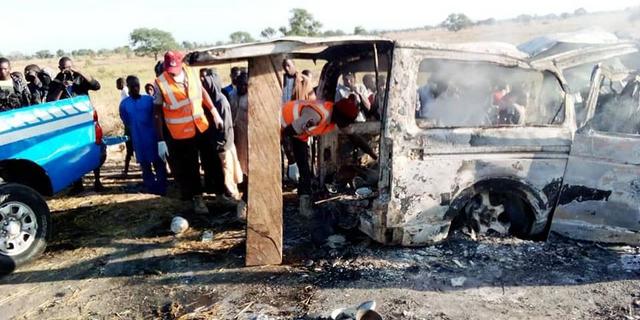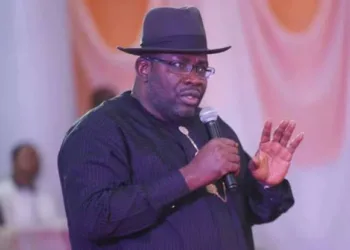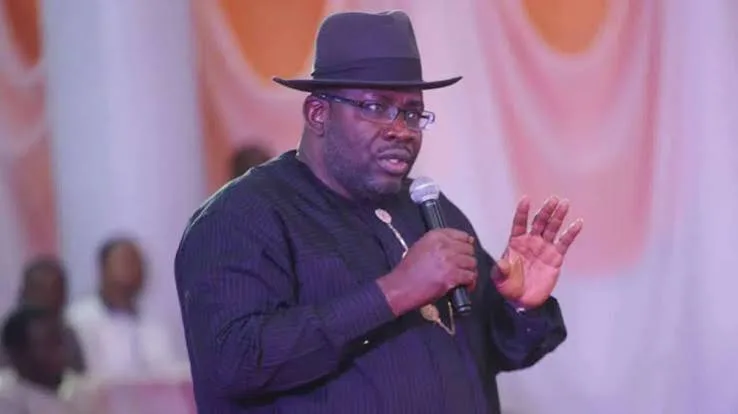

Former Bayelsa State Governor and Senator representing Bayelsa West, Henry Seriake Dickson, has urged the Federal Government to prioritise road construction in the state’s riverine communities following the Ayama/Oweikorogha boat mishap, warning that residents’ heavy dependence on water transportation continues to expose them to avoidable risks.
Dickson made the appeal on Tuesday, November 24, 2026, during a visit to survivors of the boat accident receiving treatment at the Bayelsa State Government House Clinic in Yenagoa, where he also announced a ₦5 million donation from the Nigeria Democratic Congress (NDC) towards their medical care and rehabilitation.
Also read:UN reports 47,000 women killed by relatives in 2025
The senator described the incident as heartbreaking, commiserated with families who lost loved ones and prayed for the speedy recovery of those injured.
The tragedy, he said, should serve as a wake-up call for governments and relevant authorities to strengthen maritime safety measures while addressing the infrastructure challenges that leave many communities with limited transportation options.
Dickson stressed that preventing boat accidents required more than encouraging passengers to learn swimming, noting that overloading vessels could turn routine journeys into deadly incidents.
“It is not enough that we know how to swim. If a boat designed to carry 200 passengers is overloaded with 600 or 700 people, that is a recipe for disaster,” he said.

He called for stricter monitoring of boat operators, greater public awareness of maritime safety regulations and compliance with passenger capacity limits, alongside improved enforcement of safety standards across the state’s waterways.
The former governor also urged traditional rulers, community leaders and other local stakeholders to take an active role in educating residents about safe water transportation, particularly in communities where travelling by boat remains a daily necessity.
While commending security personnel, safety officials and emergency responders involved in rescue and recovery operations, Dickson maintained that the recurring risks associated with water transportation could not be adequately addressed without tackling Bayelsa’s longstanding road infrastructure deficit.
He argued that the absence of accessible roads across many riverine communities had made water transportation unavoidable for residents travelling to schools, hospitals, markets and other essential destinations.
According to him, people living in remote communities should not be forced to depend entirely on waterways simply because alternative road connections have not been provided.
Reflecting on infrastructure projects undertaken during his tenure as governor, Dickson recalled efforts to advance the Nembe-Brass road through a partnership involving the Niger Delta Development Commission (NDDC) and Shell.
He also highlighted the commencement of the Oporoma road project, which his administration initiated despite the financial constraints facing the state at the time.
Dickson welcomed the continuation of the Oporoma road and bridge project by the current administration but insisted that additional road construction was needed to connect more isolated communities and improve movement across the state.
He specifically called for the extension of the Oporoma road to Ukubie and Koloama, the expansion of the Ekeremor road towards Agge and renewed commitment to the Nembe-Brass road project.
The senator argued that the responsibility for connecting underserved communities should not be left entirely to the Bayelsa State Government, urging the Federal Government to increase its investment in transportation infrastructure across the Niger Delta.
While acknowledging the Vice President’s visit to Bayelsa following the boat accident, Dickson appealed to the All Progressives Congress-led Federal Government to translate its expression of concern into concrete infrastructure commitments.
He called for road and bridge projects to be extended to Bayelsa and other Niger Delta communities, noting that residents in riverine areas deserved the same access to transportation infrastructure being developed in other parts of the country.
Dickson said improved road connectivity would reduce pressure on waterways, provide safer alternatives for commuters and strengthen economic activities by making it easier to transport agricultural produce, goods and services between communities.
“We are riverine people, and travelling by water is part of our way of life. Our waterways are beautiful, and river transportation can be an enjoyable experience.
“But it should be an option for leisure and convenience, not a necessity imposed on our people because there are no roads,” he said.
His remarks underline the broader development challenge confronting Bayelsa, where the state’s geographical landscape, characterised by rivers, creeks, wetlands and scattered settlements, makes road construction difficult and expensive but also heightens the importance of sustained investment in transport infrastructure.

Dickson maintained that the Ayama/Oweikorogha boat tragedy should prompt a coordinated response involving federal and state governments, maritime authorities, community leaders, boat operators and residents to improve safety and prevent further loss of lives.
Also read:UN reports 47,000 women killed by relatives in 2025
He concluded by praying for the repose of the souls of those who died in the incident and the recovery of the injured, urging authorities to ensure that the tragedy leads to lasting improvements in transportation safety and infrastructure development across the state’s riverine communities.

Mariam Balogun is a contributor to Freelanews.com, covering news, business, and public affairs.