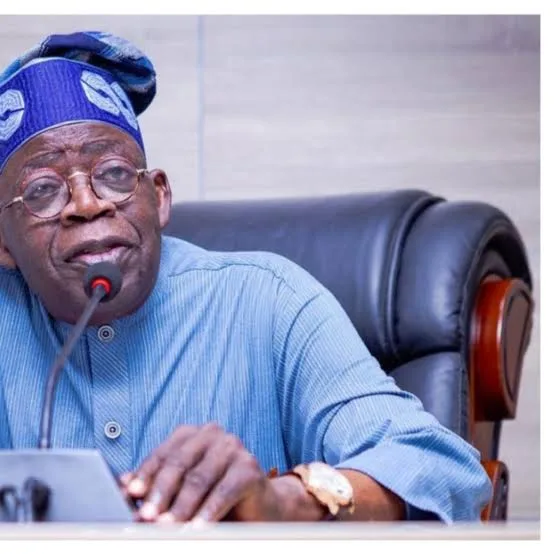

President Bola Tinubu has disclosed that Nigerian security forces have killed or arrested four of eight identified senior terrorist leaders, describing the development as evidence of sustained pressure on terrorist organisations.
Tinubu, represented by the National Security Adviser, Nuhu Ribadu, made the disclosure on Monday, November 16, 2026, at the opening of the 2026 Chief of Defence Intelligence (CDI) Annual Conference in Abuja.
The President said the security operations had targeted terrorist leadership structures, expansion networks and other operational capabilities, citing the killing of senior Islamic State leader Abu Bilal al-Minuki in May 2026 and the arrest of other prominent figures.
“Under this administration, four of the eight identified senior terrorist leaders have been killed or arrested.
“These operations reflect sustained and coordinated pressure on terrorist groups,” he said.

According to the President, the successes also included operations against Ahmed Ohida’s Islamic State West Africa Province (ISWAP) southern expansion network, as well as the arrests of Abu Barra of Ansaru and Mamuda of Mahmudawa in 2025.
He identified the four remaining senior terrorist figures as Ba Shuwa of ISWAP, Abdullahi Oro of Islamic State Sahel Province (IS-Sahel), Sadiku of Jama’atu Ahlis Sunna Lidda’awati wal-Jihad (JAS) in the North-Central region and Bakura Doro in the Lake Chad Basin.
The President said security agencies were maintaining pressure on the remaining leaders and their networks.
Al-Minuki was killed on May 16, 2026, during a joint counterterrorism operation involving Nigerian and United States forces in the Lake Chad Basin.
The United States Africa Command confirmed that its initial assessment showed that several Islamic State operatives, including al-Minuki, were killed during the operation. Nigeria’s Defence Headquarters subsequently described him as a senior Islamic State figure involved in the group’s strategic operations, financial activities and weapons development.
Over 1,000 terrorism convictions
Tinubu also disclosed that Nigeria had secured more than 1,000 convictions following over 2,000 terrorism-related trials in the last two years.
He said the figures reflected efforts by the administration to strengthen accountability and ensure that individuals involved in terrorism were brought before the courts.
The President maintained that intelligence-led military operations and improved cooperation among security agencies remained central to efforts to dismantle terrorist networks across the country.
Oil-related security incidents decline
On security challenges in the Niger Delta, Tinubu reported a decline in incidents involving illegal oil bunkering and vandalism of oil and gas installations.
According to figures presented at the conference, recorded incidents fell from 32 in the first quarter of 2026 to 21 in the second quarter and 17 in the third quarter.
The decline between the first and third quarters represented a 46.8 per cent reduction.
Tinubu attributed the improvement to sustained security operations, better intelligence gathering and increased coordination among relevant agencies.

He also disclosed that crude oil and condensate production had increased from an average of 1.68 million barrels per day towards 1.9 million barrels daily.
Tinubu seeks modern intelligence system
The President called for the modernisation of Nigeria’s intelligence architecture through the adoption of artificial intelligence, machine learning, unmanned aerial surveillance and other advanced technologies.
He said the changing nature of security threats required intelligence agencies to improve their ability to anticipate, identify and respond to emerging dangers.
Tinubu further disclosed that he had directed his Special Adviser on Homeland Security, Major General A.A. Fong, to develop a comprehensive national security strategy alongside a five-year operational plan.
He also urged security agencies to strengthen collaboration ahead of the 2027 general elections, stressing the need to protect citizens and democratic activities.
“Every Nigerian must be able to live, work and exercise their democratic rights in safety,” he said.
Earlier, the Minister of Defence, General Christopher Musa (retd.), commended intelligence personnel for their contributions to national security and urged greater cooperation among the armed forces and other security institutions.
The Chief of Defence Staff, General Olufemi Oluyede, also called for increased investment in artificial intelligence and advanced surveillance technologies to strengthen the country’s intelligence-gathering and operational capabilities.
The five-day conference, organised by the Defence Intelligence Agency, is holding from November 16 to 20, 2026, under the theme, “Optimising Intelligence Through Technological Innovation and Strategic Partnership in a Complex Security Environment.”
AbdulBasit Saba is a journalist and contributor to Freelanews.com, covering news, business, and public affairs.