
An in depth review of the Richard Akinjide historical debate, examining claims involving Chinua Achebe and Nigeria’s university politics
Ordinarily, I would let such ahistorical claims pass, but given their capacity to mislead, a correction is unavoidable. The tweet below is not just inaccurate; it is a deliberate inversion of historical cause and effect. What transpired at the Universities of Ibadan and Lagos was not an unprovoked Yoruba assault on Igbo academics, but a corrective response to entrenched Igbo nepotism and institutional capture. Unfortunately, much of Nigerian historiography has relentlessly painted the Yoruba as the primary aggressors in ethnic struggles, a narrative even echoed by some Yoruba intellectuals who neglect these critical antecedent events.
So let’s set the record straight.
First, a factual correction: Richard Akinjide became the Federal Minister of Education in 1965. The claim that he was “pushing against Igbo academia” at the Universities of Ibadan and Ife in 1962 is chronologically impossible and factually incorrect. The central events revolve around Ibadan and Lagos; the inclusion of the University of Ife here is a red herring.
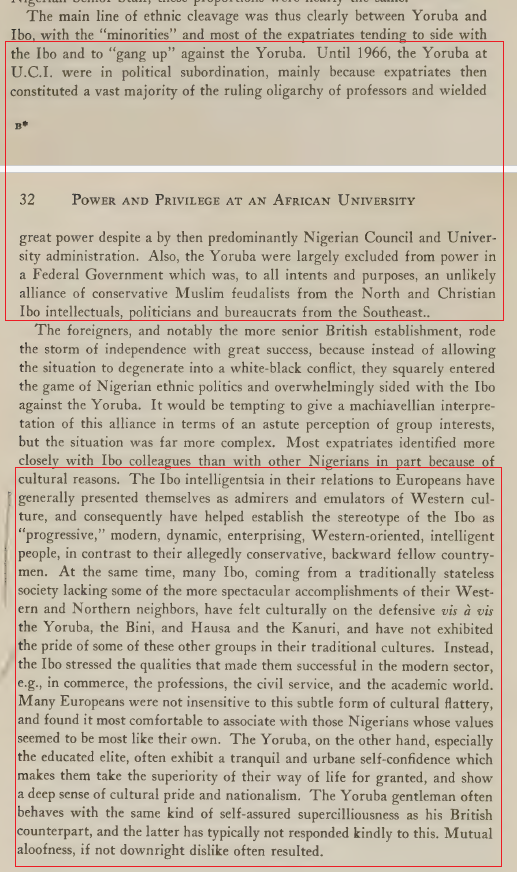
To understand the events at Ibadan, one must turn to the eyewitness account of Pierre van den Berghe (Power and Privilege at an African University), a visiting professor during this turbulent period. He identified the central dynamic: “The main line of ethnic cleavage was clearly between Yoruba and Ibo, with the ‘minorities’ and most of the expatriates siding with the Ibo and ‘ganging up’ against the Yoruba” (pg. 31).
This alliance was rooted in a cultural clash. Van den Berghe observed that the Yoruba, with their centuries-deep intellectual tradition, carried a natural cultural confidence that “makes them take the superiority of their way of life for granted, and show a deep sense of cultural pride and nationalism”. The educated Yoruba often displayed a self-assurance that the expatriates found off-putting, seeing themselves as equals with no need to ape European manners (pg. 31).
The Igbo intelligentsia, by contrast, presented themselves as eager emulators of Western culture, measuring progress by proximity to European norms. Van den Berghe notes that this posture ingratiated them deeply with expatriates and helped entrench the stereotype of the Igbo as “progressive, modern, dynamic, enterprising, Western-oriented, intelligent people”, in contrast to their allegedly “conservative, backward” compatriots. This cultural flattery forged a comfortable British–Igbo partnership that became the backbone of campus politics (pg. 31).
This dynamic took on institutional consequence in 1962 when the University College, Ibadan, became an independent university. The Vice-Chancellorship went to Professor Kenneth Dike, an Igbo historian favored by expatriates and the NCNC-led federal government, rather than to an equally qualified Yoruba candidate, Professor Ajose. This appointment was made by Aja Nwachukwu, the Igbo Minister of Education. At the same time, another Igbo academic, Professor Eni Njoku, was appointed Vice-Chancellor of the University of Lagos. In a country with only two federal universities, both were now headed by Igbo men.
Furthermore, the University of Ibadan Act, crafted by Minister Nwachukwu, appointed Dike as VC without specifying any time limit. Thus, barring removal for misconduct, Dike became, in effect, Vice-Chancellor for life.
Yet despite this glaring imbalance, there was not a single Yoruba riot, not a single newspaper meltdown, not a single declaration of persecution. The Yoruba intelligentsia accepted the situation as part of the politics of the time.
But Dike’s tenure quickly revealed a systematic pattern of ethnic preference. Van den Berghe reports that he “systematically favored fellow Ibo,” placing them in strategic positions: the Deanships of Agriculture and Medicine (both held by his relatives), the Headship of the History Department, and other key administrative offices (pg. 37 – 38). Dike’s stated goal was “ethnic balance,” but in practice, it meant prioritizing Igbo candidates even when better-qualified Yoruba candidates were available. Under him, UI increasingly resembled an Igbo fiefdom.
Dike’s methods were subtle but effective. He would promote Yoruba and Igbo candidates to the professorial level to create an appearance of fairness but reserve the real levers of power — the chairmanships, deanships, and strategic administrative roles — for Igbos (pg. 38). When obstructed, he undermined the officeholder. His campaign against the Registrar, Nathaniel Adamolekun, was the most egregious example. Dike saw Adamolekun as the final obstacle to his full consolidation of the university into an ethnic patronage system (pg. 39). His solution was to remove academic affairs from the Registry’s jurisdiction by creating an “Academic Office” under an Igbo loyalist and to bypass Adamolekun in major decisions (pg. 40).
The result was a spiraling administrative crisis. By 1966, the feud had descended into a grotesque spectacle – countermanding memos, press leaks, court injunctions, threats, office lockouts, and even police involvement.
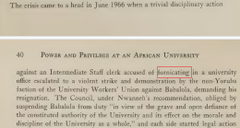
The crisis came to a head in June 1966, when a trivial disciplinary action against an Intermediate Staff clerk, most liklely a non-Yoruba, accused of fornication in a university office escalated into a violent strike and demonstration by the non-Yoruba faction of the University Workers’ Union against Adamolekun, demanding his resignation. The University Council, effectively captured by Dike’s faction, obliged by suspending Adamolekun. The injustice was so transparent that Bola Ige, a personal friend of Dike’s, represented Adamolekun against him. When Ige later recounted the story, he described Dike’s shock that he would defend a man subjected to such plainly unfair treatment.
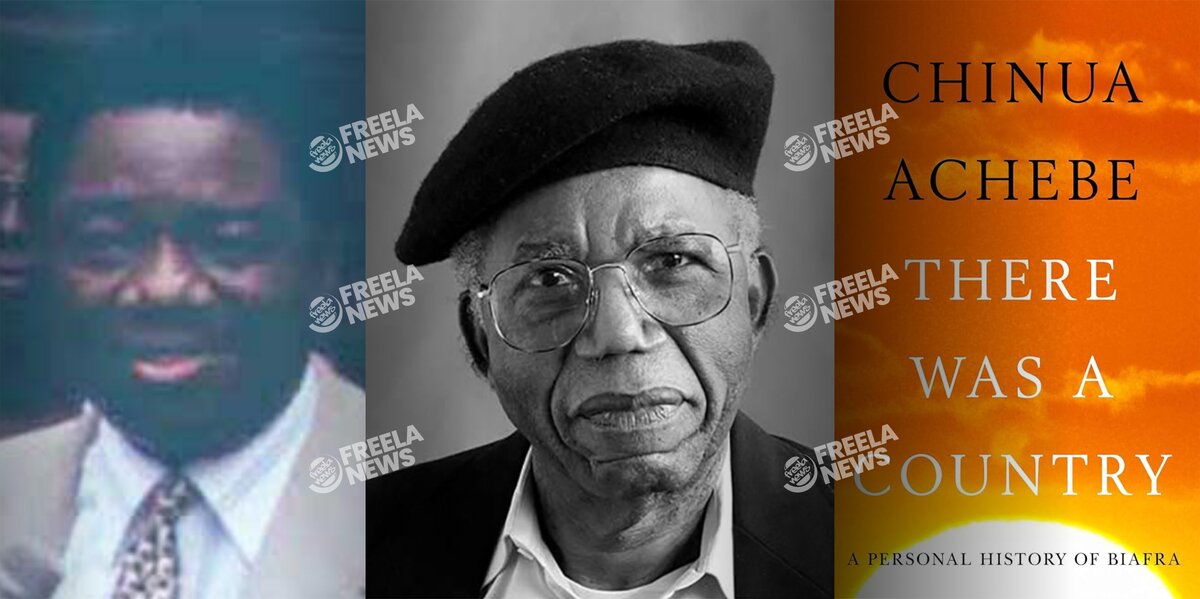
The crisis only ended when Dike resigned in late 1966 and returned to the East in the aftermath of the coup. The Gowon administration reinstated Adamolekun, restoring administrative order. Yet in Chinua Achebe’s telling, Dike becomes the victim of Yoruba small-mindedness. It is therefore laughable to read Chinua Achebe’s portrayal of Dike as a victim of “tribal small-mindedness.” To Achebe, this blatant nepotism was acceptable, the resistance to it was the sin. (Achebe, There was a Country, pg. 77)
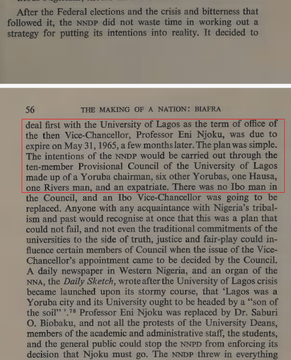
The crisis at the University of Lagos was a direct parallel. The law establishing UNILAG set a four-year term for the Vice-Chancellor. Professor Eni Njoku, appointed by fellow Igbo, Aja Nwachukwu, completed his full term on May 31, 1965. By then, Chief Richard Akinjide had become Minister of Education. Exercising his lawful discretion, he chose not to renew Njoku’s contract and appointed Dr. Saburi Biobaku. Njoku was not fired; he was offered a professorship and allowed to retain his VC salary. But the reaction from Igbo students and certain expatriate staff was immediate, violent, and politically choreographed. Riots broke out. Picketing intensified. Expatriate deans (mostly British) staged a rebellion against the Federal Government. Zik’s West African Pilot flooded the public space with inflammatory editorials about “tribalism” and “Igbo victimization,” weaponizing the press to manufacture outrage.

The Federal Government’s response was unequivocal: accusations of tribalism were baseless. Both federal universities had previously been under Igbo leadership; if anything, the Igbo had been favored. The government described the behavior of the foreign agitators as “a naked form of neo-imperialism” (Vickers & Post, Structure and Conflict in Nigeria 1960-1966, pg. 210). Chief Akinjide, not one to tolerate such interference, terminated the appointments of the expatriates who had fomented the crisis. Despite riots and an attempted murder, Prof. Biobaku eventually assumed his position.
The fundamental flaw in lies such as the one in this tweet is the neglect of antecedents. The story did not begin with Akinjide’s decision; it began with the lopsided appointments engineered by Nwachukwu, the systemic ethnic favoritism of Kenneth Dike, the patronage network built between British academics and Igbo elites, and the entrenched administrative capture at Ibadan and Lagos. But the revisionists skip all this. They begin the story at the point of correction, erase the provocations, cast Akinjide as the villain, and sanctify the architects of the imbalance.
Also read: Prof Akinkunmi Alao explores land rights and ancestry in Yorubaland
It is therefore a profound historical misrepresentation to claim that “Akinjide’s actions remain central to the Yoruba–Igbo academic struggle.” The truth is the reverse: the ethnic tensions were set in motion long before Akinjide entered the story. The actions of men like Dike and Nwachukwu, who first entangled these institutions in ethnic competition, are the true origins of the conflict. Akinjide’s role, in contrast, was an attempt to recalibrate a balance that had already been severely compromised and to reassert rightful federal oversight over institutions that had drifted into ethnic capture.
Anyone insisting otherwise is not recounting history — they are manufacturing myth.
Here is my response to the points you raised.
– On Dike’s Lifetime Appointment: While it’s true his British predecessors had indefinite terms, the context was entirely different—they were expected to be transient. The 1962 University of Ibadan Act was a prime opportunity to “Nigerianize” the statute and establish term limits, just as the contemporaneous University of Lagos Act successfully did. That this was not done for Dike was not an oversight; it was a deliberate measure to entrench his authority indefinitely.
– On the “Fornication” Incident: Your claim that Pierre van den Berghe’s book does not mention this incident is false. I have provided a screenshot of the relevant page where he details the event, using the pseudonyms “Nwanneh” for Dike and “Babalola” for Adamolekun. Your denial suggests either a failure to read the source or a deliberate misrepresentation.
– On “Ethnic Balance”: The fact that Igbos constituted 25% of the UI staff does not negate the charges of tribalism; it confirms them. Dike’s stated policy of achieving “ethnic balance” was, in practice, a pretext for systematically pruning Yoruba seniority and influence to elevate Igbos into key positions of power, regardless of merit.
– On Faculty Leadership: Your timeline is misleading. While the title “Dean” was formally adopted in 1964, the Faculty of Agriculture was led from 1962 – 1964 by Prof. A.N.A. Modebe, an Igbo appointee of Dike, in the role of “Head”, a position with powers identical to a Dean. This is a semantic distinction without a functional difference. Prof. Oluwasanmi did not become the Dean until 1964.
– On the Lack of Protest: Comparing the 1978 appointments of VCs like Akinkugbe & Baikie under a unitary military regime to the politically charged environment of the early 1960s is a dishonest sleight of hand. The two eras are not analogous. The absence of violent protest in 1962 should be understood as Yoruba restraint in the face of clear political maneuvering, not as consent.
– On Cultural Pride and Campus Tensions: Your skepticism about the cultural dynamics described by van den Berghe is unfounded. Furthermore, earlier accounts corroborate this friction. Dr. Mellanby, the first Principal of University College Ibadan, recounts on page 224 of his book, “The Birth of Nigeria’s University,” that:
“The most serious quarrel between Yoruba and Ibo students occurred in 1949 at the time when riots occurred at Enugu, and many miners, mostly Ibos, were shot. Ibo students complained that Yorubas would not take part in sympathetic movements, and I had to intervene when I found a Yoruba student besieged in his room with Ibos in the process of breaking down the door.”
This is not an isolated incident; other witnesses like Ken Saro-Wiwa documented similar intimidation tactics against Yoruba students. The British-Igbo cultural affinity was a well-documented axis of campus politics.
– On Chinua Achebe: Achebe’s hypocritical portrayal of these events, which whitewashes blatant Igbo nepotism while framing Yoruba reactions as “tribal small-mindedness,” mocks him posthumously. Only the ignorant or politically jaundiced could fail to see his manipulation of the facts.
– On Eni Njoku: The central fact remains: Njoku was not fired. His four-year term ended, and the Minister simply chose not to renew it. This was a lawful exercise of discretion, not an dismissal. Arthur Nwankwo’s work on the event confirms this (see screenshot). The actions of figures like Kehinde Adams are tangential to this fundamental truth.
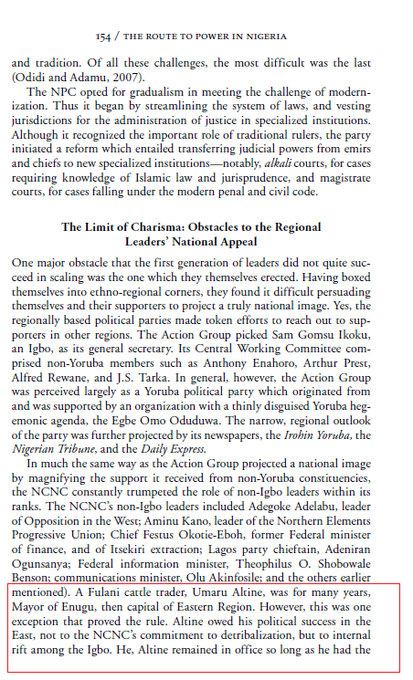
– On Umoru Altine: The story of Altine is consistently told in half to fabricate a narrative of Igbo magnanimity. The facts are:
1. Enugu only became a municipality in 1956, and Altine’s term lasted until 1958. Your claim that he was “reelected again and again” is a fabrication.

2. As M.J. Balogun noted in his book (The Route to Power in Nigeria), his ascension owed more to intra-Igbo rivalries than to any pan-ethnic goodwill. (see attached screenshot)
3. To claim there was no protest is a lie; a powerful NCNC faction led by C.O.C. Chiedozie vigorously opposed him.
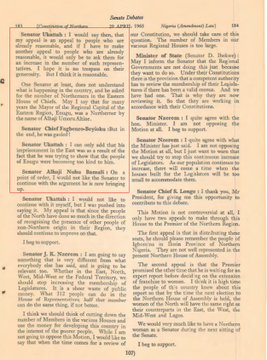
4. Crucially, by 1959, Altine was politically disgraced and jailed. As Senator Ukattah indicated, his crime, in the eyes of his Igbo detractors, was that he had “forgotten his place” as a non-Igbo (see screenshot).His story is not one of tolerance but of ultimate exclusion.
Source: Read more at brandcom.ng

Barely Educated | Night Owl | Pro-faith Secularist
De Omnibus Dubitandum