

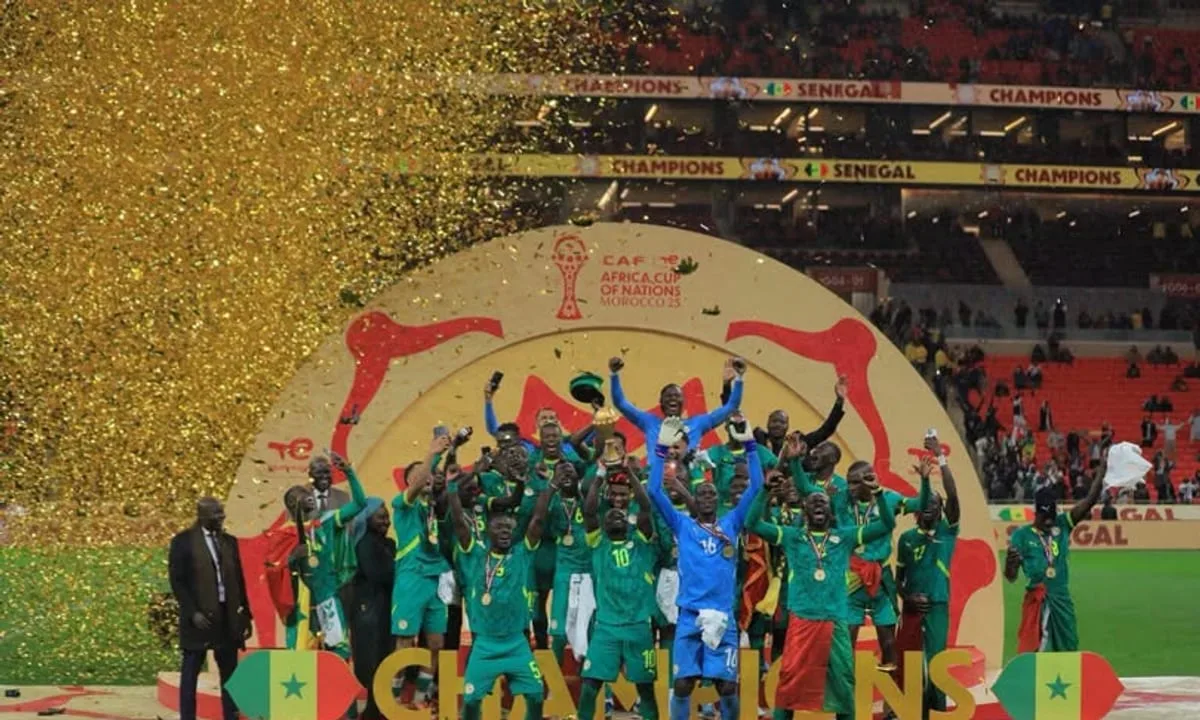

Senegal have been officially reinstated as Africa Cup of Nations 2025 champions after the Court of Arbitration for Sport (CAS) overturned the Confederation of African Football’s (CAF) decision to award Morocco a 3-0 victory in the controversial final.
The ruling restores the original 1-0 result in favour of Senegal, bringing a dramatic legal chapter in the tournament’s history to a major turning point.
Also read: Katsina suspends Daura Emir amid sexual assault probe
In its decision, CAS upheld the appeal filed by the Senegalese Football Federation against CAF and the Royal Moroccan Football Federation, setting aside the CAF Appeal Board’s ruling and reinstating the decision of the CAF Disciplinary Board.
The final, played in January, had ended with Senegal defeating hosts Morocco 1-0 after extra time.
However, the result was later overturned by CAF’s Appeal Board in March following a dispute over Senegal’s temporary walk-off during the closing stages of normal time.
The controversy began after Senegal had a goal disallowed in the 90th minute, before Morocco were awarded a late penalty.

In protest, Senegal’s players left the pitch, causing a delay of more than 15 minutes before eventually returning.
Morocco’s Brahim Diaz then attempted a Panenka penalty, but Senegal goalkeeper Edouard Mendy saved the effort.
The match continued into extra time, where Pape Gueye scored the decisive goal that secured Senegal’s victory.
Morocco subsequently challenged the outcome, arguing that Senegal had breached Articles 82 and 84 of the AFCON regulations by leaving the field without the referee’s permission.
Article 82 provides for a team to be considered the loser if it refuses to play or leaves the ground before the end of regulation time without the referee’s authorisation.
Article 84 stipulates a 3-0 defeat for a team found to have violated the provision.
CAF’s Appeal Board accepted Morocco’s argument and declared Senegal to have forfeited the final, awarding the title to the North African country.
Senegal challenged that decision at CAS, describing CAF’s ruling as unjust and insisting that the referee’s decision to allow the match to resume should be respected.
In its explanation, CAS said the referee’s decision to restart play fell within his authority and was protected by the football principle known as the field of play doctrine.
The panel noted that both teams had returned to the pitch and indicated their willingness to continue before the referee restarted the game.
According to CAS, the relevant AFCON regulations were intended to determine the outcome of a match when a team’s conduct caused the referee to abandon it permanently.
The provisions therefore did not apply in this situation because the match resumed and was completed.
The panel also rejected the suggestion that the referee’s decision was arbitrary, acknowledging the tense circumstances in which he had to make the call.
CAS said the referee’s judgment did not appear to have been influenced by factors outside the game and confirmed that his decision to continue the match was not legally flawed.
The court also noted that the Senegalese Football Federation, coach Pape Thiaw and some players had already faced separate disciplinary sanctions from CAF over the incident.
The ruling was unanimous among the three members of the CAS panel.
However, Morocco has expressed strong dissatisfaction with the decision.
The Royal Moroccan Football Federation described itself as astonished and said it intended to pursue all available legal procedures to challenge the ruling.
The Moroccan federation had also asked CAS to postpone the announcement, citing allegations that one of the panel members, Ulrich Haas, had spoken by telephone with Senegalese Football Federation president Abdoulaye Fall shortly before the decision.
CAS confirmed receiving a challenge petition shortly before the announcement but said there were insufficient grounds at that stage to delay notification of its ruling.

The possibility of further legal action remains, with Sky Sports reporting that Morocco could consider approaching the Swiss Federal Tribunal if it believes there were procedural irregularities during the CAS proceedings.
The ruling means Senegal retain the title they won on the pitch, while Morocco’s brief recognition as champions following CAF’s appeal decision has been overturned.
Also read: Katsina suspends Daura Emir amid sexual assault probe
The dispute has also drawn attention to the relationship between competition regulations and the authority of match officials, particularly when controversial incidents occur during high-pressure international fixtures.

Mariam Balogun is a contributor to Freelanews.com, covering news, business, and public affairs.