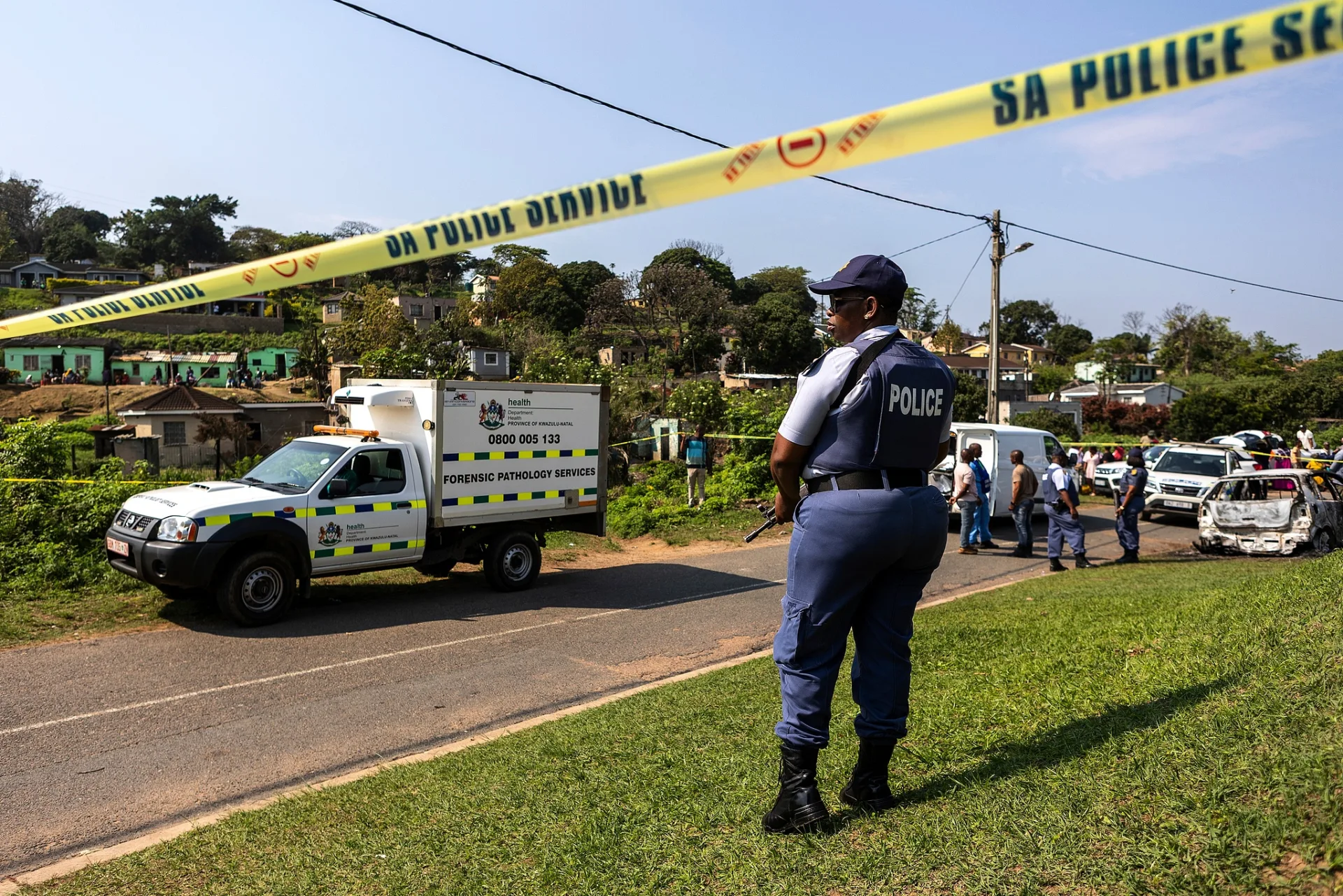

National Police Commissioner General Fannie Masemola and provincial police authorities in Gauteng and KwaZulu-Natal are investigating two separate mass shootings that claimed 17 lives in Jeffsville, near Pretoria, and Sweetwaters, outside Pietermaritzburg, South Africa, following attacks on Sunday night, 15 November, and the discovery of victims on Monday, 16 November 2026.
The killings have renewed concerns about the country’s persistent gun violence and the challenges facing law enforcement.
Also read: Nigerian-born Shirley Emehelu makes history in New Jersey
The two incidents occurred approximately 530 kilometres apart, with nine people killed in the first attack and eight men in the second.
Police have launched investigations into both cases, although the circumstances surrounding the shootings remain unclear.
Police spokeswoman Brenda Muridili confirmed the discovery, saying: “All nine were found in a shack with gunshot wounds this morning.”
The discovery has prompted investigators to examine whether the attack could be connected to previous incidents of deadly violence in the surrounding communities.

Gauteng provincial police commissioner Tommy Mthombeni reportedly said investigators were considering a possible connection with a 2025 shooting in nearby Saulsville, where 12 people were killed and 13 others wounded.
Although the possible connection provides an important line of inquiry, police have not established that the two attacks were related.
Police responded to reports of gunfire late on Sunday and subsequently discovered a bullet-riddled vehicle containing eight men with multiple gunshot wounds.
All eight victims were pronounced dead at the scene.
The victims, believed to be between 20 and 30 years old, had not been formally identified when the initial police findings were announced.
Investigators were also yet to establish whether the attack was connected to any organised criminal activity.
KwaZulu-Natal provincial police spokesman Colonel Robert Netshiunda cautioned against drawing conclusions before the investigation had progressed.
“We have seen these kinds of shootings before and there have been different motives from stock theft-related, to drugs-related to taxi violence,” Netshiunda told Newzroom Afrika.
His comments reflect the range of criminal activities that investigators have previously examined in connection with violent attacks across the province.
However, police have not attributed either of the latest shootings to any particular criminal network or dispute.
Speaking about the attacks, Masemola described the continuing violence as unacceptable and stressed the need to protect communities from criminal intimidation.
“The ongoing mass shootings which we encounter are unacceptable. Definitely, we have to find these criminals. We cannot allow them to terrorise communities or determine how people live their lives,” he said.
Masemola added that investigators would pursue every available lead, gather evidence and work towards identifying and arresting those responsible.
The latest South Africa mass shootings come against a broader backdrop of persistent violent crime, with the country continuing to record one of the world’s highest murder rates.
South African police statistics cited by Reuters indicate that approximately 60 people are killed daily on average.

The figures underline the scale of the country’s security challenges, although murder levels have also shown periods of measurable improvement.
Official figures released by Police Minister Firoz Cachalia on 22 May 2026 recorded 5,181 murders between January and March 2026, compared with 5,727 during the corresponding period a year earlier.
This represented a 9.5 per cent reduction, equivalent to 546 fewer deaths.
Despite that improvement, the average remained approximately 58 murders a day during the reporting period.
Cachalia acknowledged the continuing challenge, warning that declining crime figures did not automatically mean communities were safe.
The country’s violent crime problem has several underlying dimensions.
Criminal networks, drug trafficking, illegal mining, livestock theft and disputes over lucrative minibus taxi routes have all featured in investigations into violent incidents.
In some communities, competition over territory and economic interests has contributed to recurring confrontations, while access to illegal firearms has further complicated efforts to contain organised violence.
Previous mass shootings have also demonstrated the devastating consequences for ordinary residents.
In September 2026, at least 11 people, including a pregnant woman, were killed when gunmen attacked a gathering in KwaMakhutha near Durban.
Another shooting in Johannesburg in June left 12 people dead, with police linking the attack to suspected criminal gang activity.
Two separate shootings in December 2025 also claimed 21 lives within a fortnight.
These incidents illustrate how mass shootings have remained a recurring concern for South African authorities, even as broader crime statistics have occasionally shown improvements.
For families and residents in Jeffsville and Sweetwaters, however, the immediate concern is the loss of 17 lives and the uncertainty surrounding the circumstances of the attacks.
The identities of the eight men found in Sweetwaters were still being established, while investigators continued to examine the evidence gathered at both locations.
Police had not announced arrests or confirmed motives in either case in their initial updates.
The investigations will now be crucial in determining whether the shootings were isolated acts of violence or part of wider criminal disputes.
Also read: Nigerian-born Shirley Emehelu makes history in New Jersey
For South Africa, the latest tragedy presents another difficult test of its efforts to tackle organised violence, strengthen police investigations and restore confidence among communities living with persistent insecurity.

Mariam Balogun is a contributor to Freelanews.com, covering news, business, and public affairs.