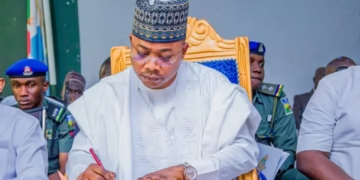
Tinubu state police amendment gains momentum as President urges House of Representatives to approve reform with safeguards against abuse
President Bola Ahmed Tinubu on Friday called on the House of Representatives to amend the Constitution to establish state police, insisting that the proposed reform must include strict safeguards to prevent abuse by state governors.
Also read: State police bill earns strong support from Ondo APC
President Tinubu made the appeal during an interfaith breaking of fast with members of the House of Representatives at the Presidential Villa, Abuja, marking his third public intervention within a week advocating the Tinubu state police amendment.
Addressing lawmakers, President Tinubu emphasised that decentralised policing must not become unchecked authority, urging legislators to design constitutional mechanisms capable of preventing misuse based on historical experience.
President Tinubu stated that security challenges across Nigeria remain largely local in nature and require collaborative institutional responses between federal and subnational authorities.


The President noted that lawmakers, through their constituency engagements, possessed firsthand understanding of insecurity affecting communities nationwide and should therefore support constitutional reforms aimed at strengthening local security architecture.
The renewed push follows similar appeals made earlier in the week to state governors and the Senate, signalling an intensified executive drive toward constitutional restructuring ahead of the 2027 general elections.
President Tinubu recently accepted the resignation of former Inspector General of Police, Kayode Egbetokun, and appointed Tunji Disu as his successor, developments widely viewed as part of broader security sector adjustments.
While outlining conditions for state police creation, President Tinubu referenced lessons from Nigeria’s First Republic, when regional policing structures were allegedly deployed to intimidate political opponents, acknowledging long-standing concerns raised by critics of decentralised policing.
Opponents of the proposal have consistently warned that governors could politicise state-controlled security outfits, while supporters argue that decentralisation would enhance rapid response, intelligence gathering and community policing.
Beyond security reforms, President Tinubu commended lawmakers for supporting key economic policies of his administration, including fuel subsidy removal and the floating of the naira, despite what he described as intense public criticism at the early stages of implementation.

President Tinubu also praised Speaker Tajudeen Abbas for providing stable leadership within the House and fostering cooperation with the executive arm.
The establishment of state police would require constitutional amendment approval by two-thirds of both chambers of the National Assembly and ratification by at least 24 state Houses of Assembly.
Nigeria continues to face complex security challenges ranging from insurgency in the North-East to banditry, kidnapping and separatist tensions across several regions, factors that have renewed national debate over policing reforms.
Also read: New Plateau state police commissioner pledges to restore peace and security
Friday’s interfaith Iftar formed part of a series of engagements hosted by the President this week involving governors, senators and federal lawmakers as discussions around security restructuring gather momentum.

Quadri Olaitan is a journalist and contributor to Freelanews.com, covering news, public affairs, and human-interest stories.