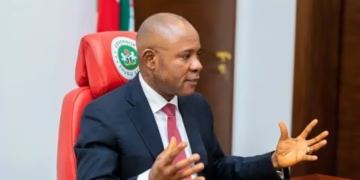
Court grants ICPC access El-Rufai devices seized in Abuja raid, allowing forensic analysis as probe continues despite former governor’s N1bn rights suit
The Federal High Court in Abuja on Thursday granted the Independent Corrupt Practices and Other Related Offences Commission permission to access and analyse electronic devices recovered from the residence of former Kaduna State Governor, Nasir Ahmad El-Rufai, as part of an ongoing investigation.
Also read: El-Rufai’s N1bn rights suit stalled over absent counsel
Justice Joyce Abdulmalik issued the order after hearing an ex parte application filed by counsel to the anti-graft agency, Osuobeni Akponimisingha, who urged the court to allow investigators to inspect and conduct forensic analysis on the items seized during a search of the former governor’s Abuja home.
In her ruling, Justice Abdulmalik authorised the commission to open and examine the devices for data extraction, including public documents, WhatsApp conversations, text messages, photographs, call logs and other digital records relevant to the investigation.
The devices listed in the court order include a Sony HD-EGS storage device, a 1TB Transcend storage drive, a Toshiba storage device, a Samsung mobile phone, a Nokia mobile phone, a Blackberry device and a Google IDEOS phone.

Other items include a Samsung storage device, a Remarkable tablet, an Apple MacBook Pro, a Seagate FreeAgent Desk external drive, a ZTE mobile phone, 10 flash drives and a Microcell memory card.
The suit, marked FHC/ABJ/CS/499/2026 and filed in the name of the Federal Republic of Nigeria against El-Rufai, empowers investigators to carry out detailed forensic examinations of the seized materials.

Meanwhile, the former governor has filed a separate fundamental rights enforcement suit challenging the legality of the search conducted at his residence. In the case marked FHC/ABJ/CS/345/2026, El-Rufai is seeking N1bn in damages for what he described as a violation of his constitutional rights.
In the application filed by his lawyer, Oluwole Iyamu (SAN), El-Rufai argued that the search of his residence at House 12, Mambilla Street, Aso Drive, Abuja, on February 19 breached his rights to dignity, personal liberty, fair hearing and privacy as guaranteed under Sections 34, 35, 36 and 37 of the Constitution.
The former governor also asked the court to declare that any evidence obtained during the search is inadmissible in any proceedings against him and sought an order compelling authorities to return all items seized from the property.
However, in a counter-affidavit, the ICPC maintained that the operation was carried out following a petition received against the former governor and was executed under a valid search warrant issued on February 18.
According to the commission, the warrant was executed on February 19 between 1:37pm and 3:56pm with the assistance of personnel from the Nigeria Police Force.

Investigators stated that the search was witnessed by El-Rufai’s wife, Hadiza El-Rufai, and his son, Mohammed El-Rufai.
The police, in a separate counter-affidavit deposed to by Inspector Ewa Anthony, also defended the operation, insisting that officers acted within their statutory powers to detect, investigate and prosecute criminal offences.
Also read: El-Rufai’s N1bn rights suit against ICPC hits setback
Police authorities further argued that due legal procedures were followed during the search and urged the court to dismiss the former governor’s suit, describing it as an attempt to obstruct a lawful investigation.

Quadri Olaitan is a journalist and contributor to Freelanews.com, covering news, public affairs, and human-interest stories.