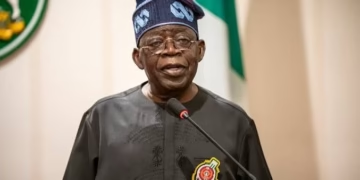
Nigeria’s Defence Minister urges regional leaders to bridge political divisions and coordinate efforts against terrorism, insurgency and cross-border crime
Nigeria’s Minister of Defence, Christopher Musa, on Tuesday called for stronger ECOWAS-AES security ties during a three-day working visit to Cotonou, Benin Republic, urging leaders of the two regional blocs to overcome political differences and develop a coordinated response to terrorism, insurgency and transnational crime.
Also read: ECOWAS backs major $25bn African gas pipeline
Musa said West Africa’s increasingly complex security environment required closer cooperation between the Economic Community of West African States and the Alliance of Sahel States, particularly to prevent insurgent groups from exploiting porous borders and to strengthen maritime security in the Gulf of Guinea.
Speaking during meetings with Beninese officials, the minister stressed that the region could not afford fragmented responses to threats that increasingly crossed national boundaries.
“There is a need for a unified security alliance between the ECOWAS and the Alliance of Sahel States to defeat terrorism, dismantle cross-border criminal networks, and restore regional stability,” Musa said.
He urged the leadership of both blocs to find common ground to prevent the spread of insurgency across land borders while improving security along the Gulf of Guinea.

The minister’s appeal comes against the backdrop of a significant political divide in West Africa.
Burkina Faso, Mali and Niger formally withdrew from ECOWAS on January 29, 2025, after years of tensions with the regional bloc following military takeovers in the three countries and disagreements over sanctions and the restoration of civilian rule.
The three countries subsequently strengthened their cooperation through the Alliance of Sahel States, creating a separate framework for military, political and economic coordination.
Despite the split, the security threats confronting the region remain closely connected.

Terrorist organisations and criminal networks continue to operate across national borders, while arms trafficking, violent extremism, kidnapping and other forms of organised crime pose persistent challenges to governments and local communities.
Musa argued that closer coordination could help prevent insecurity in the Sahel from spreading further south towards coastal West African countries.
He also highlighted the importance of securing the Gulf of Guinea, where piracy, maritime crime and illegal trafficking have previously threatened commercial shipping and regional economic activity.
The Nigerian minister was received at Cotonou International Airport by Benin’s Minister of National Defence, Gildas Agonkan, who praised Nigeria’s role in supporting peace and stability across West Africa.
Agonkan also commended Nigeria for its contributions to regional security and democratic governance, describing the country as an indispensable partner in the fight against transnational crime.
He specifically praised the Nigerian Army contingent that participated in Benin’s National Day parade on August 1.
During his visit, Musa also met Nigerian troops stationed at Togbin, where he conveyed President Bola Tinubu’s commitment to improving their welfare, strengthening operational effectiveness and providing the armed forces with greater capacity to respond to security threats.
The engagement with the troops formed part of the minister’s wider effort to reinforce Nigeria’s role in regional security cooperation while maintaining attention on the welfare of personnel deployed outside the country.
Musa later visited Nigeria House in Cotonou, where he met Nigeria’s Ambassador to Benin Republic, Mopelola Ibrahim.

Ibrahim said Nigeria’s diplomatic engagement with Benin remained focused on deepening bilateral trade and improving joint border surveillance to respond to emerging security challenges.
The latest diplomatic push reflects the growing recognition that West Africa’s security challenges cannot be addressed effectively by individual countries acting alone.
For Nigeria, which shares borders with Benin and Niger and has long faced threats from terrorist groups and criminal networks in the wider region, stronger regional intelligence sharing and coordinated border operations remain particularly important.
The relationship between ECOWAS and the AES, however, remains politically complicated.
The withdrawal of Burkina Faso, Mali and Niger created a major fracture within West Africa’s traditional regional security architecture, even as the countries continue to face many of the same threats as their former ECOWAS partners.
Musa’s call for renewed cooperation therefore represents a potentially significant shift towards practical security collaboration despite the political differences separating the two blocs.
Whether the appeal can translate into a sustained security framework will depend on the willingness of ECOWAS and AES leaders to rebuild trust and establish mechanisms for cooperation.
For communities facing terrorism, insurgency and cross-border crime, however, the need for such cooperation is increasingly urgent.
Also read: ECOWAS parliament urges stronger regional trade
A more unified regional approach could offer a powerful opportunity to strengthen border security, disrupt criminal networks and improve stability across West Africa.

Oreoluwa is an accountant and a brand writer with a flair for journalism.