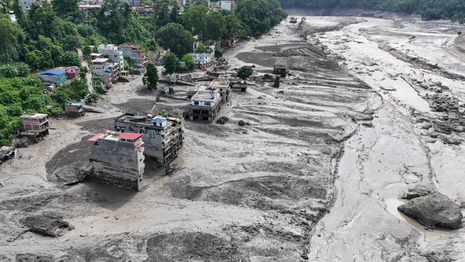

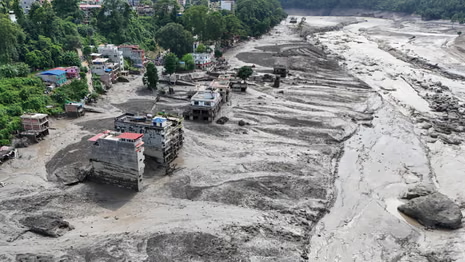
Deadly flash floods and landslides devastate border communities as rescue teams search for missing tourists and residents
The Nepal-Tibet floods have killed at least 160 people and left hundreds missing after a catastrophic surge of mud, rock and water swept through communities along the Himalayan border on Wednesday, August 26, 2026, devastating parts of Nepal’s Rasuwa district and China’s Gyirong County.
Also read: FULL LIST: Nigeria ranks 56th among world’s 60 poorest economies
Nepali authorities said 157 bodies had been recovered, while Chinese state media reported three deaths on the Tibetan side. More than 400 people remain unaccounted for, with tourists, pilgrims, workers and local residents among those missing. (Reuters)
The disaster struck with extraordinary force, washing away homes, roads, bridges and power infrastructure and cutting off parts of the mountainous region.
Rescue operations have been complicated by damaged roads, disrupted electricity supplies and rivers running dangerously high. (bdnews24.com)

Nepal’s tourism authorities said 484 tourists were reported missing, including 391 foreigners and 93 Nepalis.
Among the foreign nationals were 133 Indians, many travelling towards Mount Kailash in Tibet, as well as 47 Americans, 34 Australians, 33 Britons and 24 Canadians. (ABC News)
The route is particularly busy at this time of year because of pilgrimages to Kailash Manasarovar, one of the most important religious destinations for Hindus.
Eight South Koreans working at a hydropower project were also reported missing. South Korean authorities said rescue efforts were being coordinated with Nepal while preparations were made to deploy a rapid-response team. (Al Jazeera)
The destruction has left families desperately searching for relatives.
Keshav Prasad Baral, a 68-year-old survivor, described watching his wife disappear beneath the advancing mud.
“It was a huge gush of mud coming straight towards us,” Baral said. He said he tried to take his wife to safety when the mud entered their home, but she was swept away.
Hours later, Baral was rescued by helicopter, but his wife remained missing beneath the debris.
Another survivor reportedly escaped by clinging to a mango tree while watching the building where he had been working disappear beneath the torrent.
The scale of the destruction became apparent in videos showing people running from a wall of mud, rocks and water as it overwhelmed buildings and vehicles near the Nepal-China border. (Reuters Connect)
Satellite analysis by Planet Labs indicated that a landslide involving ice and rock triggered a debris-filled surge in the Lhende River, about 19 kilometres northeast of the Rasuwagadhi border crossing. (Reuters)
The precise sequence of events remained under investigation.
Early reports linked the disaster to a 4.4-magnitude earthquake recorded in the area, while disaster researchers said an ice and rock avalanche or landslide may have blocked the river before releasing a sudden and destructive surge downstream. (Reuters)
The International Centre for Integrated Mountain Development said the Lhende Khola had experienced severe flooding twice within 14 months, with researchers pointing to an ice-rock avalanche as the likely trigger for Wednesday’s event. (Al Jazeera)
Climate scientists have also warned that rising temperatures are destabilising high-altitude terrain, increasing the risk of landslides, icefalls and other hazards in mountain regions.
The consequences have extended well beyond homes and communities. Nepal’s electricity infrastructure suffered significant damage, with about 430 megawatts of generation capacity reportedly affected. (Al Jazeera)
In Rasuwa, helicopters struggled to land in badly affected areas including Syapru Besi and Timure because of the swollen rivers and difficult terrain.


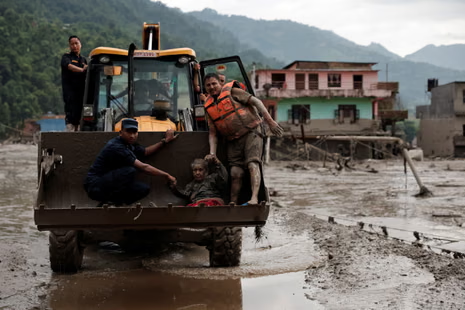
Nepali Prime Minister Balendra Shah ordered security agencies to intensify rescue operations and urged people living in vulnerable areas to move to safer locations.

“People along the river are advised to exercise extra caution and remain alert,” Shah said.
Across the border, the situation was equally grave.
Chinese state media reported that a mudslide struck the Gyirong port in Tibet, severing roads, communications and electricity links.
Three people had been confirmed dead and 265 remained missing, although authorities cautioned that the figures were still being verified. (KVue)
Chinese President Xi Jinping ordered an all-out search for those missing and called for stronger monitoring and early-warning systems to prevent further disasters.
The Chinese military deployed drones to assess the damage, while aircraft, helicopters and other rescue equipment were placed on standby. (Reuters)
The flooding has also prompted concern downstream in India. Authorities in Bihar began evacuating residents from vulnerable districts, with thousands of people moved to safer locations as floodwaters threatened communities along rivers flowing from the Himalayan region. (Al Jazeera)
The tragedy has revived painful memories of last year’s Bhote Koshi flooding, which killed nine people and left 24 missing after a supraglacial lake drained in Tibet.
That disaster also destroyed a bridge connecting Nepal and China, disrupting trade and transport for months.
The latest catastrophe is another stark reminder of the vulnerability of Himalayan communities to sudden mountain hazards.
Seasonal monsoon rainfall has long contributed to flooding and landslides across South Asia, while scientists increasingly warn that climate change is intensifying risks in fragile high-altitude environments. (Al Jazeera)
For families gathered outside rescue centres in Nepal, however, the scientific explanations offer little comfort. Many are still waiting for names, phone calls or any sign that missing relatives have survived.
As rescue teams continue searching through mud and debris, the full human cost of the Nepal-Tibet floods remains uncertain.
Also read: 10 Nigerians seek asylum after 2026 World Cup
Authorities on both sides of the border have warned that the casualty figures could rise significantly as isolated communities become accessible and the scale of the destruction becomes clearer. (bdnews24.com)

Victory Emmanuel is a journalist and contributor to Freelanews.com, covering news, business, and public affairs.