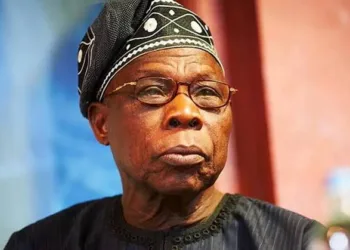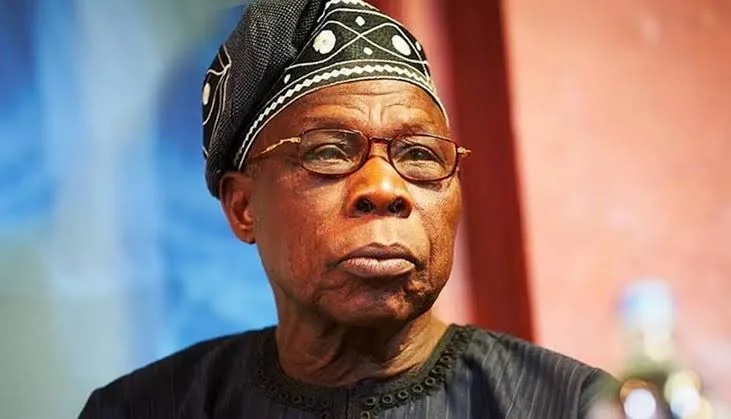

Former President Olusegun Obasanjo has criticised President Bola Tinubu over the handling of petrol subsidy removal, accusing his administration of failing to put adequate plans in place to cushion the economic impact on Nigerians.
Obasanjo made the remarks during an interview with News Central Television, where he questioned the timing and preparation behind the Tinubu administration’s decision to end the petrol subsidy in May 2023.
Also read:Two Nigerians rescued from sex trafficking in Mali
According to the former president, a government preparing to implement a major economic reform should first assess its likely consequences and establish measures to protect citizens, particularly low-income households.
He argued that removing subsidy without adequate arrangements to absorb the resulting shock placed an immediate burden on Nigerians, while relief measures came much later.
“A serious leader studies the shock before he acts. He stocks buffers. He phases the pain so that ordinary people do not suffer at once,” Obasanjo said.
He further criticised the government’s approach, describing it as one in which the announcement came before the necessary preparations.

“A prepared president does not announce ‘Subsidy is gone’ on day one and invent palliatives months later,” he said.
Obasanjo also questioned the Tinubu administration’s three-point agenda, asking who designed it and what specific objectives it was intended to achieve.
He maintained that the hardship experienced by Nigerians since the subsidy removal reflected the consequences of implementing major policies without sufficient preparation.
The former president cited the rising cost of food, transportation and fuel as examples of the economic pressure households have faced.
Nigeria’s petrol subsidy was removed shortly after Tinubu assumed office on May 29, 2023, when he declared during his inauguration that the subsidy was gone.
The decision triggered a sharp increase in petrol prices and contributed to wider cost-of-living pressures.
The International Monetary Fund (IMF), in its 2024 assessment of Nigeria’s economy, acknowledged that the government had reformed fuel subsidies but noted that adequate compensatory measures for poorer households had not been scaled up in a timely manner.
It also reported that the cash transfer programme was subsequently paused amid corruption concerns.

However, the Federal Government has defended the policy, arguing that the subsidy had become financially unsustainable and that retaining it would continue to place pressure on public finances.
The Ministry of Finance says measures introduced to ease the impact include wage awards, support to states, conditional cash transfers, student loans and a compressed natural gas (CNG) transport programme.
Tinubu has also maintained that the subsidy will not be restored, insisting that resources previously spent on it should instead be directed towards infrastructure, education and other development priorities.
Obasanjo, however, argued that leadership should be measured not by policy announcements or political slogans but by the level of preparation behind decisions and the protection provided to ordinary citizens.
He urged Nigerians to reflect carefully before voting in the 2027 general election, saying their choices would have significant implications for the country’s future.
Also read:Two Nigerians rescued from sex trafficking in Mali
The latest criticism adds to a series of public disagreements between the former president and Tinubu over the administration’s economic policies and handling of national affairs.

Mariam Balogun is a contributor to Freelanews.com, covering news, business, and public affairs.