


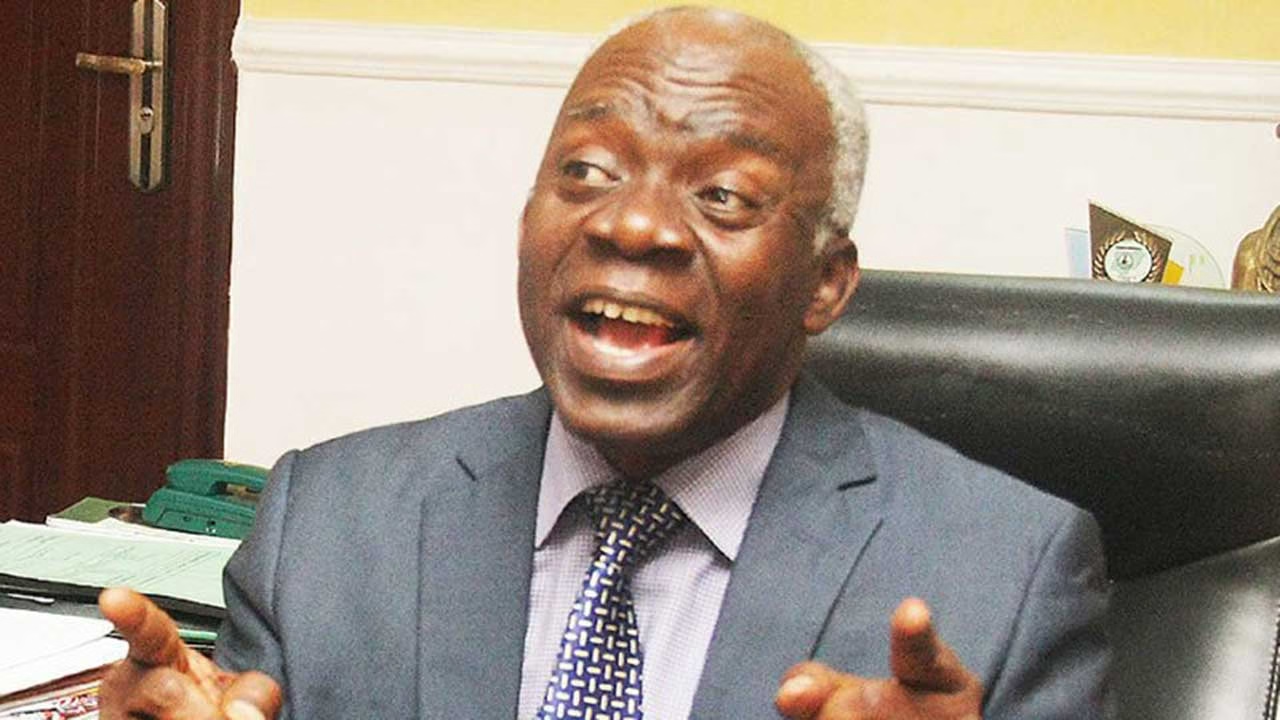

The SAN says the anti-graft agency acted within the law, provided it obtained judicial approval within the required period
Senior Advocate of Nigeria and human rights lawyer Femi Falana said on Friday, August 7, 2026, that the Economic and Financial Crimes Commission acted within its legal powers when it restricted an Osun State Government account, provided the commission obtained a court order within the prescribed period.
Also read: Osun-Osogbo Festival enters grand finale with global attention
Falana made the clarification while speaking on Channels Television’s Politics Today amid growing controversy over the EFCC’s restriction of an Osun State statutory allocation account less than two weeks before the state’s August 15 governorship election.
The lawyer said the legal position on the EFCC’s authority to place government accounts under restriction had already been considered by the courts.

“Well, as far as the law is concerned, the EFCC has not acted illegally,” Falana said.

He explained that the commission could initially place a Post No Debit restriction on an account for up to 72 hours while pursuing judicial authorisation.
“Under the law, the EFCC has the power to freeze the account of the federal government or of any state or local government in Nigeria,” he said.
Falana traced the position to a 2022 judgment of the Court of Appeal arising from an earlier dispute involving the Benue State Government.
In 2019, the Federal High Court in Makurdi had ruled against the EFCC’s restriction of Benue government accounts and awarded ₦50 million in damages against the commission.
The EFCC appealed the decision, and the Court of Appeal in September 2022 overturned the lower court’s judgment.
The appellate court held that the EFCC could place state government accounts under a Post No Debit restriction for up to 72 hours without first obtaining a court order for investigative purposes. It also set aside the damages awarded against the commission.
“That remains the law in Nigeria today,” Falana said.
The SAN also referred to a 2024 Supreme Court judgment involving Kogi State and other states, which challenged the legal foundation and nationwide operation of the laws establishing the EFCC, the Independent Corrupt Practices and Other Related Offences Commission and the Nigerian Financial Intelligence Unit.
The Supreme Court dismissed the states’ challenge in November 2024, holding that the relevant laws had been validly enacted by the National Assembly and that the agencies’ powers could be exercised nationwide.
Falana said the judgment reinforced the legal authority of anti-corruption agencies to investigate financial activities involving public institutions.
“In 2024, the Kogi State government, joined by many state governments, challenged the investigation, probing of state accounts by EFCC, ICPC, or NFIU,” he said.
“And in a historic judgment, the Supreme Court examined all the relevant laws and came to the conclusion that these agencies have the power to probe the accounts of any organisation, either at the federal, state, or local government level.”
His comments come against the backdrop of an increasingly sensitive political and legal dispute in Osun, where Governor Ademola Adeleke is seeking re-election in the August 15 governorship poll.

The EFCC has said its action followed suspicious movement of funds linked to an ongoing investigation into the alleged handling of about ₦11 billion in Ecology Funds, Intervention Funds and Federation Account Allocation Committee allocations.
The commission has maintained that the restriction was temporary, applied to one account and grounded in its statutory powers under the EFCC Act and the Money Laundering (Prevention and Prohibition) Act.
The timing of the action has nevertheless generated political debate because the election is only days away.
President Bola Tinubu subsequently directed the EFCC to approach the court to vacate the order and discontinue the action, citing concerns over its timing so close to the election.
Falana, however, stressed that the legal dispute should not be confused with the question of when the EFCC chose to act.
He said the Osun State Government had challenged the legality and validity of the court order itself.
“The President referred to the order obtained by the EFCC. And as should be done, the Osun State government has challenged the legality, the validity of the order, not the timing,” he said.
The lawyer also warned against creating a precedent in which anti-corruption investigations are effectively suspended whenever an election approaches.
He argued that such an approach could make public funds vulnerable to abuse during politically sensitive periods.
“Because we must also be very careful that we don’t give a dangerous impression that when elections are 10 days away, 20 days away, 30 days away, the anti-graft agencies must turn the other eye,” Falana said.
He added that investigations should not be abandoned merely because elections are approaching, particularly where large sums of public money are involved.
His position places the current controversy within a longer-running debate over the balance between anti-corruption enforcement, state financial autonomy and the political sensitivities surrounding elections.
The 2022 Benue case remains particularly relevant because the Court of Appeal expressly recognised the EFCC’s ability to impose a temporary restriction on state government accounts while investigations are under way.
At the same time, the current Osun matter remains subject to judicial scrutiny.
Falana’s interpretation does not itself determine whether the specific court order obtained by the EFCC was properly issued or whether every procedural requirement was satisfied in the circumstances.
The distinction is significant.
The broader legal authority of the EFCC may be established by precedent, while the validity of a particular restriction can still be challenged based on the facts, evidence and procedure involved.
The controversy also unfolds against a highly charged electoral backdrop.
Osun voters are scheduled to elect a governor on August 15, with the Independent National Electoral Commission reporting more than 2.3 million eligible voters for the poll.
For Falana, however, the proximity of the election should not by itself prevent lawful scrutiny of government finances.
His argument is ultimately that any change to the existing legal framework should come through legislation rather than an informal restriction on the powers of anti-graft agencies.
“If Nigerians, those who are concerned, want the law changed, they can go to the National Assembly,” he said.
“But for now, as of today, EFCC has the power to freeze the account of any state and, in not more than 72 hours, has to go to court.”
Also read: Tinubu launches ₦216.7bn Osun road projects
The statement adds a powerful legal voice to an increasingly contentious dispute, while leaving the courts to determine whether the specific steps taken in the Osun case complied fully with the law.

Quadri Olaitan is a journalist and contributor to Freelanews.com, covering news, public affairs, and human-interest stories.


