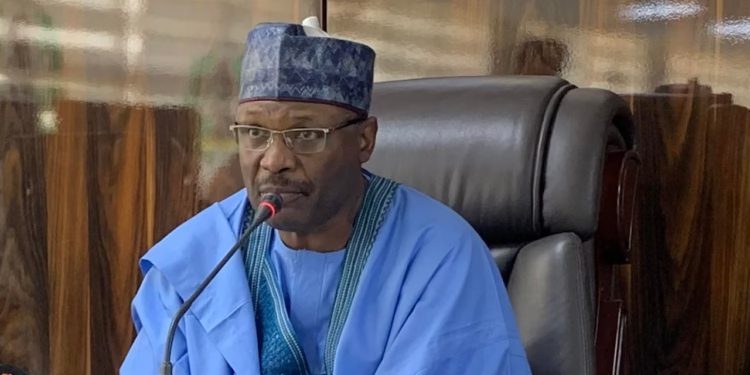
FG renews push to end Local Government Funds Interference as RMAFC plans monitoring and backs possible executive action for council autonomy
The Federal Government on Thursday renewed its pledge to end Local Government Funds Interference by state governments, as the Chairman of the Revenue Mobilisation Allocation and Fiscal Commission, Mohammed Shehu, outlined fresh measures to safeguard financial autonomy for the 774 councils.
Also read: FG proposes N3.6tn electricity subsidy deduction from FAAC
Mohammed Shehu spoke in Abuja during the 2025 budget performance appraisal and 2026 budget defence organised by the House of Representatives Committee on Finance, where the commission signalled plans to reintroduce a Local Government Committee to monitor allocations nationwide.
Mohammed Shehu lamented what he described as persistent encroachment by state authorities on council finances and declared that the commission was prepared to take concrete action to restore functionality at the grassroots.
The chairman disclosed that the President had personally warned state governors that an Executive Order could be issued if efforts to guarantee local government autonomy were frustrated, a stance the commission fully supports.

Mohammed Shehu argued that weak local governance lay at the heart of Nigeria’s developmental challenges, adding that councils were more effective even under past military administrations.
The chairman also commended the House Committee on Finance, led by Abiodun Faleke, for strengthening the commission’s institutional standing and improving cooperation with major revenue-generating agencies, including the Nigerian Customs Service and the Nigerian Upstream Petroleum Regulatory Commission.
Mohammed Shehu further revealed that the commission had conducted an audit of oil assets across the Niger Delta and was close to concluding work on a new revenue allocation formula for the three tiers of government and political office holders.
The proposed remuneration framework for political office holders, Mohammed Shehu said, had been submitted to the President through the Secretary to the Government of the Federation and would soon be transmitted to the National Assembly for legislative action.

After the presentation, Abiodun Faleke praised the management of the commission for its role in enhancing revenue oversight and accountability in the country.
Local Government Funds Interference has remained a contentious issue in Nigeria’s federal structure for decades.
Although the 1999 Constitution recognises local government administration, allocations have frequently been channelled through State–Local Government Joint Accounts, enabling state governments to withhold or redirect council funds.

Observers, civil society groups and labour unions have long linked this practice to poor service delivery in rural communities, weak primary healthcare and education systems, and the erosion of grassroots governance.
Also read: FG begins accreditation for new federal permanent secretaries
Recent Supreme Court pronouncements and renewed federal pressure have returned the issue to national focus, with the Federal Government signalling a tougher and more decisive approach to enforce financial independence for local councils.

Quadri Olaitan is a journalist and contributor to Freelanews.com, covering news, public affairs, and human-interest stories.