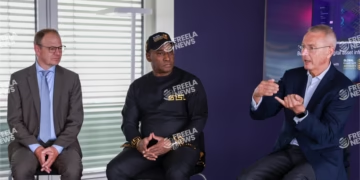
SEC digital asset transactions hit $96bn in Nigeria as the commission boosts regulation of cryptocurrency and virtual asset markets
The Securities and Exchange Commission (SEC) has disclosed that Nigeria’s digital finance ecosystem recorded about $96 billion in cryptocurrency and other virtual asset transactions, highlighting the sector’s rapid growth and the need for stronger regulatory oversight.
Also read: MEXC drives TradFi-crypto convergence with tokenized assets
The disclosure was made by Emomotimi Agama, Director-General of the SEC, during a Citizens and Stakeholders Engagement Session organised by the Federal Ministry of Finance in Abuja on Monday.
Agama emphasised that the scale of activity in the digital asset market requires robust monitoring to safeguard investors and maintain market stability.
“As we speak today, it is a known fact from research and statistics that virtual asset service providers and cryptocurrency operations account for $96 billion in transaction flow in Nigeria, and that is important for us to manage,” Agama said.

The SEC boss explained that regulatory powers have been reinforced with the Investment and Securities Act 2025, which positions the commission as the apex regulator of the Nigerian capital market and introduces provisions to monitor systemic risks while aligning operations with global standards.
Agama highlighted the capital market’s significant contribution to Nigeria’s economy, noting that about ₦3.68 trillion worth of new capital market issues were approved in 2024 across equity and fixed-income instruments.
The market also supported more than 31 banks during recapitalisation exercises to meet new capital requirements.
The Director-General said total market capitalisation has risen sharply from roughly ₦55 trillion in 2024 to about ₦127 trillion currently, while the ratio of market capitalisation to gross domestic product has grown from 13 per cent to around 33 per cent.
Investor protection remains a priority. Agama disclosed that the SEC issued over 90 advisory notices warning Nigerians about risky investment schemes and unregistered platforms, while cracking down on fraudulent operations, including Ponzi schemes, in collaboration with the Nigeria Police Force.
The capital market has also supported infrastructure development through subnational bond issuances by state governments.


Agama explained that projects such as markets, stadiums, and other public facilities have been financed through these bonds, with repayments secured via the Irrevocable Standing Payment Order system.
In addition, the SEC has established an Office of Municipal Fund Development to help state and local governments access capital market funding for grassroots development projects.
The commission also supported the launch of the Mortgage Refinancing and Infrastructure Fund, aimed at addressing Nigeria’s housing deficit by providing long-term financing for mortgages at single-digit interest rates.
Looking forward, Agama said the SEC plans to deepen Nigeria’s capital market by increasing the market capitalisation-to-GDP ratio from roughly 30 per cent toward levels seen in emerging markets such as India, where the ratio stands at about 92 per cent.
Also at the session, the Permanent Secretary of the Federal Ministry of Finance addressed budget implementation challenges, citing lower-than-expected oil revenues, rising debt obligations, and increased salary commitments.
Also read: MEXC urges caution as crypto hype fuels risky bets
The ministry has introduced weekly cash management meetings to monitor finances, with plans to implement a single national budget from 2026 onward to improve fiscal efficiency.

Quadri Olaitan is a journalist and contributor to Freelanews.com, covering news, public affairs, and human-interest stories.